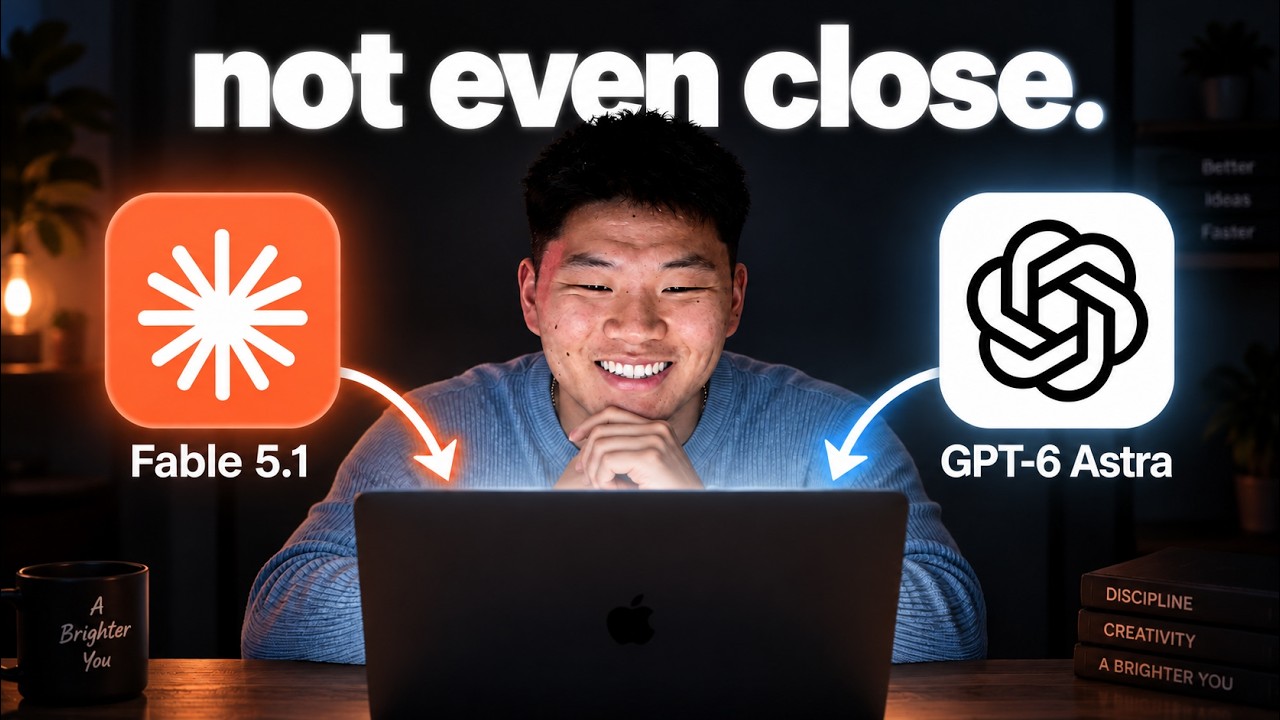
100 Hours Testing GPT-6 Astra vs Fable 5.1. What You Need to Know.
Keywords
Summary
145 words
Critical Evaluation
Value of the Information & Strength of the Argument
The video provides valuable hands-on insights into the practical performance of two leading AI models. The creator’s argumentation is based on direct experimentation across diverse use cases, which adds credibility to his observations. He systematically compares outputs, time, and cost, allowing viewers to understand trade-offs. However, the evaluation is subjective, relying on personal taste and specific business needs, which limits generalizability. The creator acknowledges this by encouraging viewers to conduct their own tests. The cost analysis is particularly useful for budgeting, though the reasons for cost discrepancies are not always fully explained. Overall, the video offers actionable information for AI practitioners, but the lack of rigorous methodology and potential bias from promotional content should be considered.
Scientific Rigor, Source Quality, Title Accuracy
The video is a practical demonstration rather than a scientific study, so it lacks formal citations. The creator references his own experience and outputs, which are not independently verifiable. The description includes links to his agency, free resources, and tools, which are promotional and not sources for the claims made. The title accurately reflects the content, and the video is well-structured with clear timestamps. The creator’s methodology is transparent, but the absence of external validation and the subjective nature of the evaluations reduce the scientific rigor. The video does not engage with academic literature or official documentation, relying instead on anecdotal evidence. The adequacy between title and content is strong, as the video delivers on its promise of a 100-hour test across 15 use cases.
256 words
Title / Content Match
The title accurately reflects the content: a 100-hour comparative test of GPT-6 Astra and Fable 5.1 across 15 use cases, with practical insights.
Quality & Reliability
6/10
The video presents a hands-on comparative test of two AI models across 15 use cases, with detailed observations on output quality, time, and cost. However, the methodology is subjective and lacks rigorous controls (e.g., no blind evaluation, no statistical analysis). The creator's expertise is practical rather than academic, and the video includes promotional content for his agency and tools.
Chapters
Cited Sources
- AI Automation Society - Playbook for $1M AI Agency — Promotional link for the creator's agency growth playbook.
- Glaido - Voice to Text (Free Month) — Affiliate link for a voice-to-text tool used by the creator.
- Hostinger VPS - Claude Code Hosting — Affiliate link for VPS hosting, mentioned as a tool used.
- Nate Herk on LinkedIn — Creator's professional profile.
- AI Automation Society - Free Resources — Link to the creator's community and free resources.
Concurring Sources
- AI model comparison methodologies — Provides a framework for evaluating AI models, supporting the need for systematic testing.
Dissenting Sources
- Academic benchmarks for AI models — Standard benchmarks like MMLU or HumanEval are not referenced in the video, which relies on subjective real-world tasks.
Contribution & Novelties
The video offers a unique, practical comparison of two AI models across a wide range of real-world business tasks, providing detailed cost and time analysis. This is valuable for professionals deciding which model to adopt for specific use cases. The creator’s approach of testing on actual business scenarios (e.g., taxes, email audits, video editing) is more relatable than benchmark tests. However, the conclusions are subjective and based on a single user’s experience, limiting their generalizability.
Pour aller plus loin :
- AI model comparison methodologies — Overview of evaluation methods.
- Cost-benefit analysis in AI adoption — Framework for assessing economic viability.
- Prompt engineering best practices — Techniques to optimize model outputs.
110 words
Radar Profile
The radar profile shows high scores in quantity of information and moderate scores in quality and reliability, reflecting the video's extensive practical testing but subjective evaluation. The technical level is moderate, suitable for a general audience interested in AI applications.