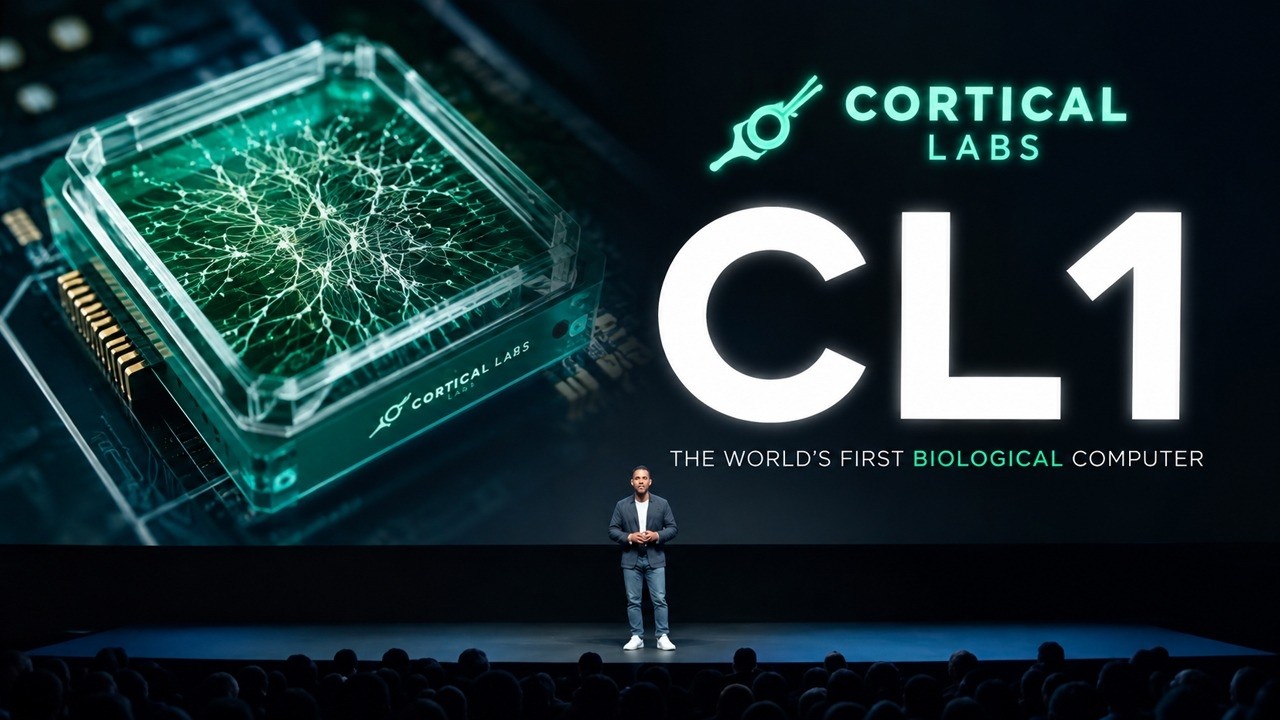
They Just Made a Chip With Living Human Brain Cells
Keywords
Summary
134 words
Critical Evaluation
Value of the Information & Strength of the Argument
The video provides valuable insights into a cutting-edge scientific field, presenting a balanced view that includes both the potential benefits and the ethical dilemmas. The argumentation is generally solid, supported by references to specific research and researchers. However, it sometimes uses sensational language and makes speculative leaps, such as comparing organoid intelligence to the Matrix, which may overstate the current capabilities. The inclusion of multiple perspectives, from researchers to bioethicists, strengthens the overall argument, though the narrator’s own conclusions are presented with a certain bias towards the biological approach.
Scientific Rigor, Source Quality, Title Accuracy
The video demonstrates a good level of scientific rigor by citing specific studies and providing links to sources in the description. The sources are reputable (e.g., IEEE Spectrum, The Guardian, university press releases). The title accurately reflects the content, though it is somewhat sensational. The video does not clearly distinguish between established facts and the narrator’s interpretations, which could mislead viewers. The use of expert interviews and references to peer-reviewed work adds credibility, but the lack of critical analysis of the cited studies is a minor weakness.
191 words
Title / Content Match
The title is catchy and accurately reflects the core topic of the video, which is the integration of living human brain cells with silicon chips for computing.
Quality & Reliability
7/10
The video is a well-structured documentary that presents a range of ongoing research in organoid intelligence, citing specific institutions and researchers. It includes links to primary sources in the description, which enhances credibility. However, it blends factual reporting with speculative commentary and some rhetorical flourishes, and the sources are not always clearly distinguished from the narrator's interpretation.
Chapters
Cited Sources
- Machine Learning Algorithm Can't Distinguish These Lab Mini-Brains from Preemie Babies — Source for the claim about UC San Diego organoids showing baby-like electrical activity.
- Biological Computer for Sale — Source for the Cortical Labs CL1 biological computer.
- Petri-dish brain cells playing Doom - Cortical Labs — Source for the claim that living brain cells learned to play Doom.
- Organoid Intelligence: Biocomputers — Source for the Johns Hopkins research on organoid intelligence.
Concurring Sources
- Machine Learning Algorithm Can't Distinguish These Lab Mini-Brains from Preemie Babies — Supports the claim about organoid electrical activity.
- Biological Computer for Sale — Supports the existence of commercial biological computers.
Dissenting Sources
- Response to 'In vitro neurons learn and exhibit sentience when embodied in a simulated game' — A commentary in Neuron journal criticizing the sentience claims made by Cortical Labs.
Contribution & Novelties
The video offers a compelling overview of the current state of organoid intelligence, synthesizing recent developments from multiple labs and framing them within a broader discussion about the future of computing and consciousness. It provides a unique perspective by contrasting the biological approach with traditional AI, highlighting the potential advantages of living neurons.
Pour aller plus loin :
- Organoid intelligence (OI) — Wikipedia article on the concept.
- Cortical Labs — Company website with information about their CL1 platform.
- Thomas Hartung’s research — Johns Hopkins faculty page.
- Karl Friston’s free energy principle — Theoretical framework mentioned in the video.
98 words
Radar Profile
The radar profile shows a balanced performance across all dimensions, with slightly higher scores in information quantity and quality, reflecting the video's comprehensive coverage and use of credible sources. The technical level is moderate, making it accessible to a general audience while still providing depth.
💬 The overall sentiment is positive and enthusiastic, with many viewers expressing amazement and excitement about the technology. On the 30 comments analyzed, the tone is largely supportive, with some humorous and speculative remarks, but also a few critical questions about scalability and ethics.