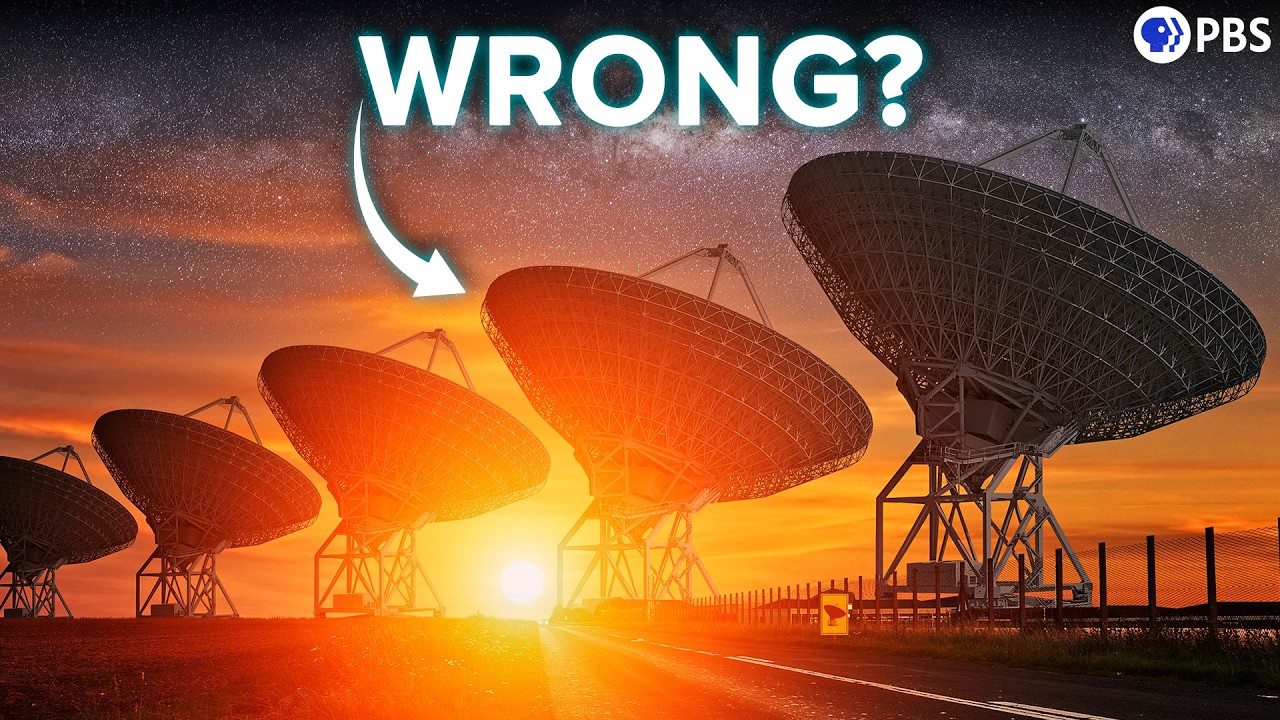
We’ve Been Searching for Aliens the Wrong Way. That’s All About To Change. . .
Keywords
Summary
170 words
Critical Evaluation
Value of the Information & Strength of the Argument
The video provides valuable information by synthesizing recent scientific papers and proposals, offering a clear and compelling argument for updating SETI strategies. The argumentation is solid, logically progressing from the limitations of early radio searches to the potential of modern laser technology and commensal surveys. It effectively uses concrete examples, such as the HARPS data reanalysis and the Rubin Observatory’s alert system, to illustrate the feasibility of new approaches. The reasoning is well-structured and avoids sensationalism, presenting a balanced view of the possibilities and challenges.
Scientific Rigor, Source Quality, Title Accuracy
The video demonstrates high scientific rigor by referencing specific papers (e.g., by Ben Zuckerman, Benjamin Fields and Jason Goodman, Eleanor Gallay et al.) and upcoming missions (Habitable Worlds Observatory, SKA). It clearly distinguishes between established facts (e.g., prevalence of exoplanets) and speculative proposals (e.g., alien behavior). The title accurately reflects the content’s focus on the paradigm shift in SETI. The video is produced by a reputable channel with a history of accurate science communication.
174 words
Title / Content Match
The title accurately reflects the content, which argues that traditional SETI methods are outdated and that new observational capabilities will transform the search for extraterrestrial intelligence.
Quality & Reliability
8/10
The video is a well-structured science communication piece by a reputable channel (PBS Space Time), hosted by astrophysicist Matt O'Dowd. It presents a balanced overview of current SETI strategies, referencing recent papers and upcoming surveys. While it is not a peer-reviewed source itself, it accurately represents the scientific consensus and clearly distinguishes between established facts and speculative proposals.
Key Moments
Markers derived by PSI from the transcript: the creator did not define chapters.
- Introduction to the problem: 65 years of SETI with no confirmed signals.
- Discussion of Zuckerman's paper and the three key points: transmission tech, targeting, energy.
- Argument that any detectable civilization is likely much older and more advanced than us.
- Shift to laser-based communication and the ability to target specific planets.
- Introduction of commensal SETI and the potential of piggybacking on existing surveys.
- Focus on the Rubin Observatory and its data brokers for anomaly detection.
- Discussion of the Square Kilometre Array and its potential for radio technosignature searches.
- Conclusion: new surveys will transform our ability to find technosignatures.
Cited Sources
- PBS Space Time Patreon — Support the channel and get access to Discord.
- Space Time Merch Store — Merchandise including the Fates of the Universe UV Glow T-shirt.
- Space Time Mailing List — Sign up for episode notifications.
- Space Time Library Search — Search the entire Space Time library.
- End Credits Music by J.R.S. Schattenberg — Music for the end credits.
Concurring Sources
- PBS Space Time Patreon — Supports the channel and community.
- Space Time Merch Store — Merchandise related to the episode.
- Space Time Mailing List — Newsletter for episode updates.
- Space Time Library Search — Search tool for past episodes.
- End Credits Music by J.R.S. Schattenberg — Music credit.
External References
Contribution & Novelties
The video provides a clear and accessible synthesis of recent proposals to modernize SETI, emphasizing the shift from narrow-band radio searches to commensal, anomaly-detection-based approaches using next-generation observatories. It highlights the importance of considering advanced civilizations’ capabilities and the potential of existing data archives.
Pour aller plus loin :
- Ben Zuckerman’s paper on SETI strategy — Directly referenced in the video, this paper outlines the proposed updates to SETI search strategies.
- Habitable Worlds Observatory — NASA’s future mission to directly image exo-Earths, mentioned as a successor to the Terrestrial Planet Finder.
- Rubin Observatory Legacy Survey of Space and Time (LSST) — The survey that will enable commensal SETI through its massive data flow and alert system.
- Square Kilometre Array (SKA) — The radio telescope that will provide unprecedented sensitivity for potential radio technosignature searches.
134 words
Radar Profile
The radar profile shows a well-rounded video with high scores in information quantity, quality, and technical level, and a slightly lower but still strong reliability score. This indicates a content-rich, technically sound, and trustworthy science communication piece.
💬 Positif. Sur les 30 commentaires analysés, le climat est très positif, avec des éloges pour la qualité du contenu, des références nostalgiques à SETI@home, et des discussions enthousiastes sur les nouvelles méthodes de recherche.