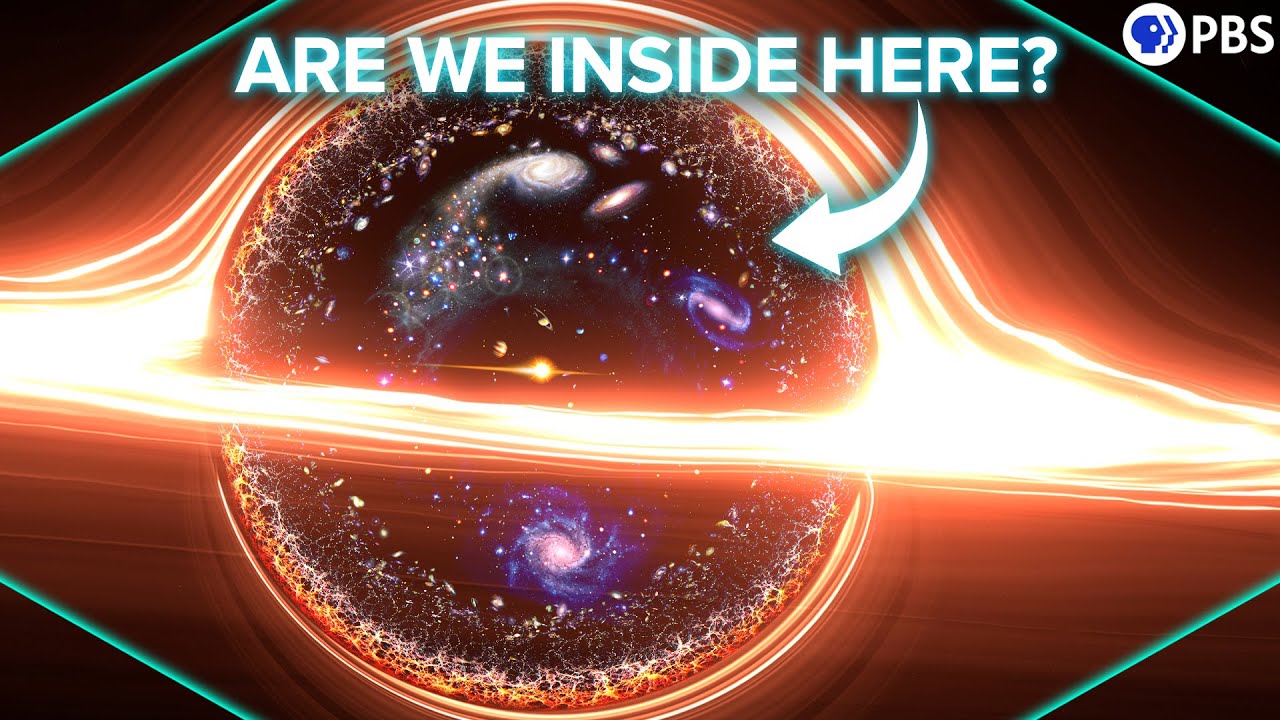
Could The Universe Be Inside A Black Hole?
Keywords
Summary
176 words
Critical Evaluation
Value of the Information & Strength of the Argument
The video provides a valuable overview of a speculative cosmological idea, connecting it to established physics concepts. The argumentation is logical and well-structured, building from basic black hole physics to the more exotic white hole and universe-in-a-black-hole scenarios. It effectively uses analogies and visualizations to make complex ideas accessible. However, the video does not critically evaluate the hypothesis in depth, and the conclusion is somewhat weak, acknowledging the lack of evidence without exploring potential counterarguments or alternative explanations.
Scientific Rigor, Source Quality, Title Accuracy
The video demonstrates scientific rigor by grounding its discussion in established theories like general relativity and the FLRW metric. It references historical hypotheses (Pathria, Smolin) and Hawking’s work, though without formal citations. The title accurately reflects the content. The video is part of a reputable PBS series, known for its educational quality. The lack of explicit source citations in the description is a minor weakness, but the content is consistent with mainstream physics.
166 words
Title / Content Match
The title accurately reflects the central question explored in the video, which is whether our universe could be inside a black hole.
Quality & Reliability
8/10
High-quality science communication by an established PBS series, with clear explanations of general relativity, FLRW metric, and historical hypotheses. The content is well-structured and accurate, though it presents speculative ideas without deep critical analysis.
Key Moments
Markers derived by PSI from the transcript: the creator did not define chapters.
- Introduction to the question: could the universe be inside a black hole?
- Explanation of black holes and event horizons in general relativity.
- Comparison of the Big Bang singularity to a black hole singularity.
- Introduction of white holes and their potential to contain a universe.
- Discussion of the Oppenheimer-Snyder solution and FLRW metric.
- Conclusion: the hypothesis is possible but not supported by evidence.
Cited Sources
- PBS Donation Page — Support for PBS Member Stations.
- Space Time Fan Survey — Audience feedback survey.
- Space Time Mailing List — Newsletter sign-up.
- Space Time Merch Store — Merchandise store.
- End Credits Music by J.R.S. Schattenberg — Music credit for end credits.
Concurring Sources
- Black hole cosmology — Discusses the hypothesis that our universe is inside a black hole, referencing Pathria's work.
- White hole — Provides background on white holes and their properties.
Dissenting Sources
- No direct discordant sources found — The video presents a speculative hypothesis without strong evidence, but no explicit counterarguments are provided.
Contribution & Novelties
The video synthesizes existing ideas about black holes, white holes, and cosmology into a coherent narrative, making the speculative hypothesis of a universe inside a black hole accessible to a general audience. It highlights the mathematical parallels between black hole singularities and the Big Bang, and discusses historical proposals like Pathria’s and Smolin’s, providing a broader context.
Pour aller plus loin :
- Black hole — Overview of black hole physics.
- White hole — Theoretical concept of a time-reversed black hole.
- Friedmann–Lemaître–Robertson–Walker metric — Metric describing a homogeneous, isotropic expanding universe.
- Cosmological natural selection — Lee Smolin’s hypothesis about black holes as universe creators.
- Oppenheimer–Snyder model — Early model of gravitational collapse.
111 words
Radar Profile
The radar profile shows high scores in information quantity and quality, with a slightly lower technical level, indicating a well-balanced educational video that is accessible yet informative. The reliability score is high, reflecting the credibility of the PBS Space Time series.
💬 Très positif. Sur les 30 commentaires analysés, les spectateurs expriment un enthousiasme marqué pour le sujet, avec des réflexions personnelles et des questions approfondies, sans critiques négatives notables.