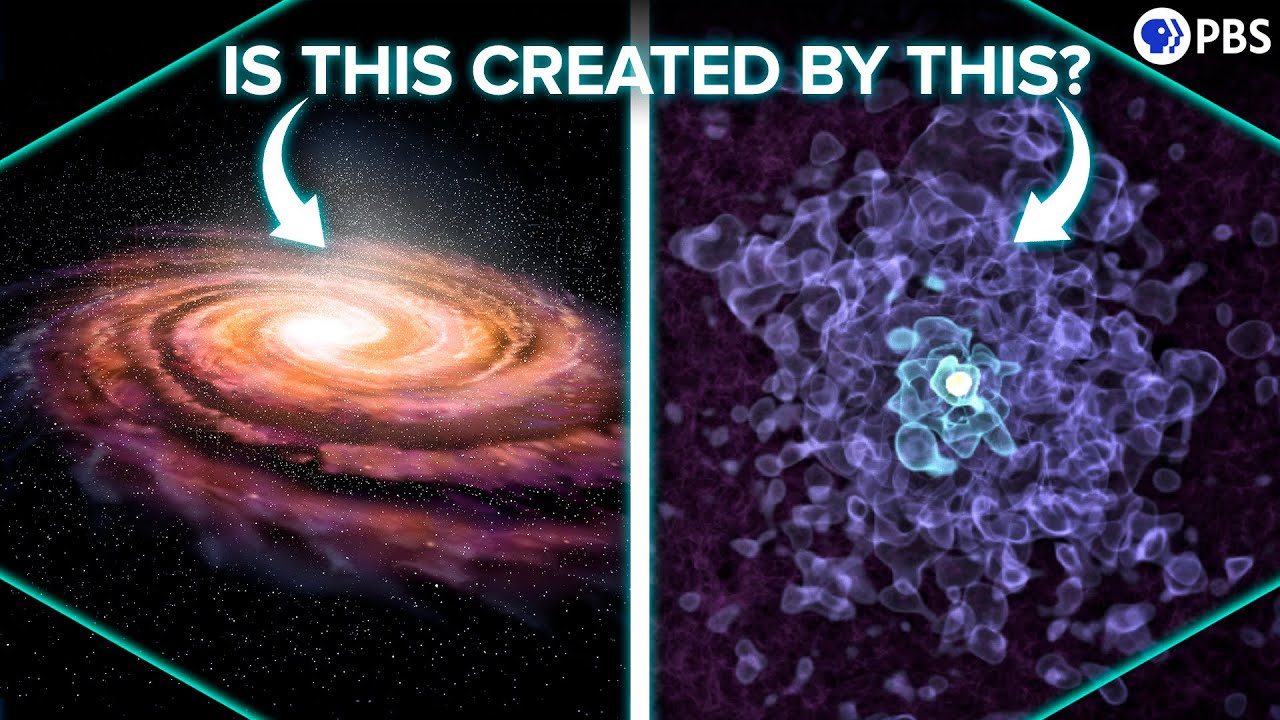
Does Axionic Dark Matter Bind Galaxies Together?
Keywords
Summary
190 words
Critical Evaluation
Value of the Information & Strength of the Argument
The video provides a high-value, in-depth explanation of a complex topic, making it accessible to a scientifically literate audience. The argumentation is logically structured, building from the basics of dark matter and WIMPs to the quantum mechanics of axions and their potential observational consequences. The host effectively uses analogies (e.g., ripples in a pond) to illustrate abstract concepts. The presentation is balanced, acknowledging both the strengths and uncertainties of the axionic dark matter hypothesis. The video also connects the topic to broader cosmological models (Lambda-CDM) and ongoing research, adding to its value.
Scientific Rigor, Source Quality, Title Accuracy
The scientific rigor is high, with accurate descriptions of quantum mechanics, superfluids, and cosmological structure formation. The video clearly distinguishes between established physics and speculative extensions. However, it does not cite specific scientific papers or provide direct references to the research discussed, which limits its utility as a primary source. The title accurately reflects the content, and the video’s production quality is excellent. The comments section shows a positive reception, with viewers appreciating the clarity and depth of the explanation.
187 words
Title / Content Match
The title accurately reflects the content, which focuses on the axionic dark matter hypothesis and its potential to explain galactic-scale phenomena.
Quality & Reliability
8/10
The video presents a well-structured, technically accurate overview of axionic dark matter, grounded in established physics (QCD axion, Bose-Einstein condensates, Lambda-CDM). It clearly distinguishes established science from speculative extensions (fuzzy dark matter, string theory). The host is a known astrophysicist, and the channel has a strong reputation for accuracy. However, the video does not provide direct citations to specific papers, and some claims (e.g., the exact mass range for fuzzy dark matter) are presented without detailed sourcing.
Key Moments
Markers derived by PSI from the transcript: the creator did not define chapters.
- Introduction to dark matter and the cold dark matter (CDM) model.
- Discussion of WIMP dark matter and its formation of halos.
- Introduction to axions and their quantum wave-like nature.
- Explanation of how axions form a superfluid (Bose-Einstein condensate).
- Comparison of axionic and WIMP dark matter gravitational effects.
- Discussion of fuzzy dark matter and its potential to solve structure formation problems.
- Detection prospects and concluding remarks on axionic dark matter.
Cited Sources
- PBS Space Time Patreon — Support page for the show.
- PBS Space Time Merch Store — Merchandise store.
- PBS Space Time Mailing List — Sign-up for episode notifications.
- PBS Space Time Library Search — Search the entire Space Time library.
- End Credits Music by J.R.S. Schattenberg — Music for the end credits.
Concurring Sources
- Axion (Wikipedia) — General reference on axions, consistent with the video's description.
- Fuzzy cold dark matter (Wikipedia) — Supports the discussion of fuzzy dark matter and its cosmological implications.
Dissenting Sources
- No direct sources provided — The video does not cite specific papers, so no discordant sources are identified.
External References
Contribution & Novelties
The video provides a clear and accessible synthesis of the axionic dark matter hypothesis, explaining how ultra-light particles could form a superfluid and behave as a wave on galactic scales. It effectively contrasts this with the standard WIMP model and highlights potential observational signatures. The video’s originality lies in its pedagogical approach, connecting quantum mechanics to cosmology in an intuitive way.
Pour aller plus loin :
- Axion (Wikipedia) — A comprehensive overview of the axion particle, its theoretical motivation, and experimental searches.
- Bose-Einstein condensate (Wikipedia) — Background on the state of matter that axionic dark matter would form.
- Fuzzy dark matter (Wikipedia) — More details on the specific low-mass axion model discussed in the video.
115 words
Radar Profile
The radar profile shows high scores across all dimensions, indicating a well-rounded and reliable educational video. The strongest aspects are the quality and technical depth of the information, while the quantity of information and overall reliability are also strong, though slightly lower due to the lack of explicit citations.
💬 Très positif. Sur les 30 commentaires analysés, les spectateurs expriment une admiration marquée pour la clarté et la profondeur de l'explication, avec plusieurs soulignant que c'est l'un des meilleurs épisodes récents de la chaîne.