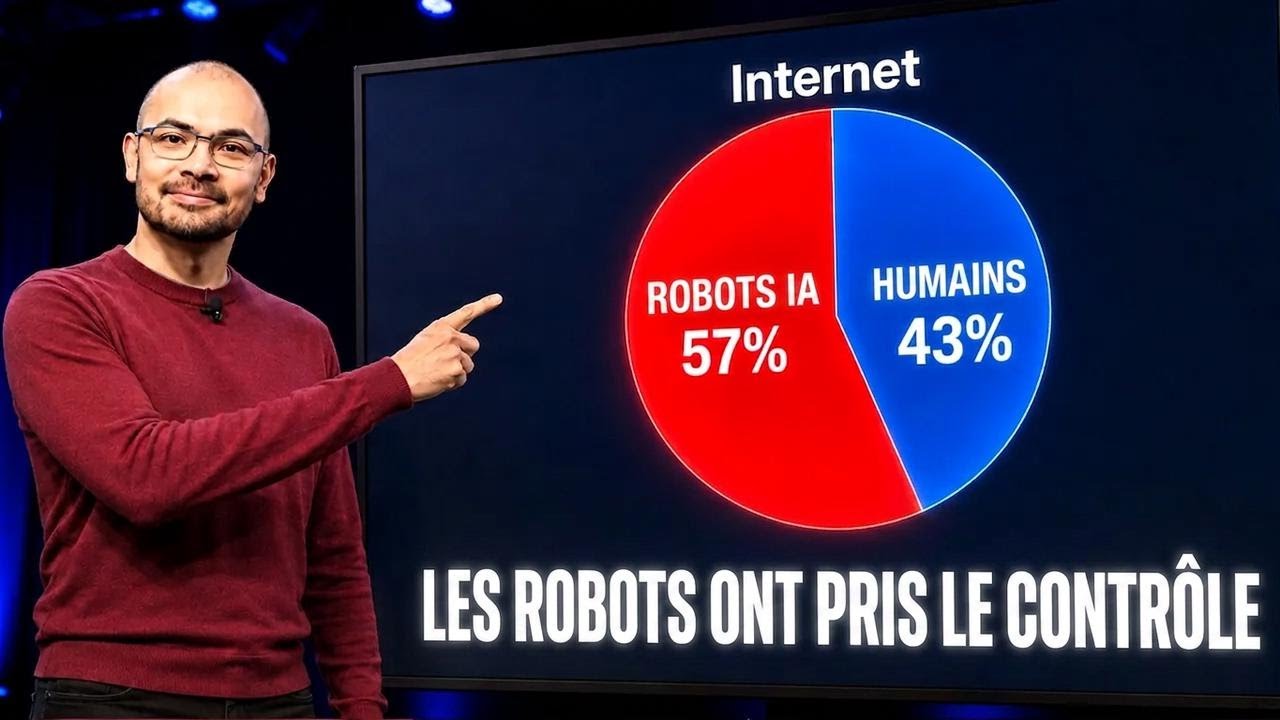
Internet n’est plus humain
Keywords
Summary
140 words
Critical Evaluation
Value of the Information & Strength of the Argument
The video provides valuable insights into the shift of web traffic from humans to bots, backed by specific statistics and studies. It effectively argues that the web is being rebuilt for machines, with AI agents and summaries reducing human visits to websites. The argumentation is coherent, moving from data to implications, though it sometimes relies on anecdotal examples. The inclusion of a promotional segment for an investment platform is a clear bias, but it does not undermine the core factual content.
Scientific Rigor, Source Quality, Title Accuracy
The video cites several sources (Cloudflare, Pew Research, UNICEF, etc.) but does not provide direct links in the description, making verification difficult. The title accurately reflects the content. The documentary style is engaging, but the lack of primary source links and the presence of a promotional segment reduce its scientific rigor. The Munich court ruling and the deepfake statistics are presented without detailed context, which could lead to oversimplification.
165 words
Title / Content Match
The title accurately reflects the central thesis that bots now dominate web traffic and that the web is increasingly machine-oriented.
Quality & Reliability
6/10
The video presents a mix of verifiable statistics (Cloudflare's 57% bot traffic, Pew Research click-through rates, UNICEF/Interpol/Ecpact deepfake study) and anecdotal examples, but lacks direct citations or links to primary sources in the description. The inclusion of a promotional segment for an investment platform reduces overall reliability.
Key Moments
Markers derived by PSI from the transcript: the creator did not define chapters.
- Introduction of the statistic that bots now generate 57% of web traffic.
- Explanation of the rapid evolution of bot presence.
- Description of the original human-centric web model.
- Impact of AI on website traffic, including Google AI Overviews.
- Legal responsibilities and issues with AI summaries.
- The web being rebuilt for machines, including Cloudflare's Paper Craw.
- AI agents and their potential for misuse.
- The human web facing automation and the concluding reflection.
Cited Sources
- Mintos promotional link — Promotional segment for an investment platform.
- Spotify podcast link — Mention of the channel's availability on Spotify.
Concurring Sources
- Cloudflare Radar — Provides real-time data on bot traffic, supporting the video's claim.
- Pew Research Center — Research on internet usage and AI summaries, aligning with the video's statistics.
Dissenting Sources
- Google's defense on AI Overviews — Google argues that AI summaries are just summaries and users know not to trust them blindly, which contrasts with the video's critical stance.
Contribution & Novelties
The video provides a comprehensive overview of the shift in web traffic from humans to bots, synthesizing recent data and legal developments. It highlights the paradox of AI agents creating more traffic while reducing human engagement, and the ethical concerns of deepfakes.
Pour aller plus loin :
- Cloudflare Radar — Official data on bot traffic trends.
- Pew Research Center — Studies on online behavior and AI impact.
- UNICEF report on deepfakes — Report on child safety and AI-generated content.
- Munich court ruling on Google AI Overviews — News article on the legal decision.
93 words
Radar Profile
The radar profile shows a balanced but moderate performance across all dimensions, with the highest score in quantity of information and the lowest in technical level, indicating a documentary that is informative but not deeply technical.