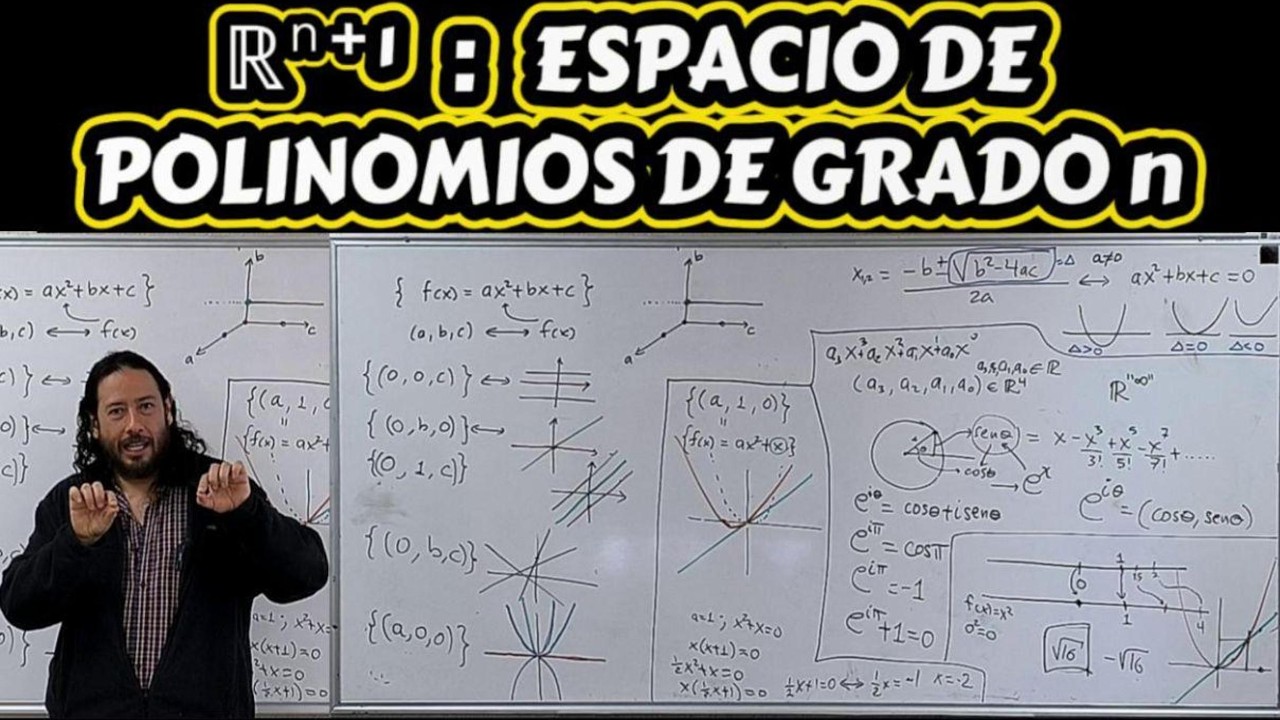
ℝⁿ⁺¹: Espacio de polinomios de grado n (Efraín Vega Landa)
ℝⁿ⁺¹: Space of polynomials of degree n (Efraín Vega Landa)
Keywords
Summary
186 words
Critical Evaluation
Value of the Information & Strength of the Argument
The lecture provides a valuable pedagogical approach to understanding polynomials as elements of a vector space, offering a geometric intuition that is often missing in standard algebra courses. The argumentation is solid: the instructor carefully constructs the space ℝ³ for quadratics, then uses limiting arguments (as a→0) to show how parabolas degenerate into lines, reinforcing the condition a≠0. The reasoning is consistent and builds on prior knowledge, making the abstract concept of a vector space tangible. However, the lecture is primarily explanatory and does not introduce new mathematical results; its value lies in the clarity of exposition and the visual framework it provides.
Scientific Rigor, Source Quality, Title Accuracy
The lecture is mathematically rigorous, with careful attention to edge cases and logical consistency. The instructor explicitly addresses the condition a≠0 and its geometric meaning, which is a sign of thoroughness. The sources are not explicitly cited, but the content is standard mathematics, and the lecture is part of a university series (UNAM), lending it credibility. The title accurately reflects the content, as the lecture indeed explores the space of polynomials of degree n, focusing on the geometric interpretation. The description provides relevant keywords but no external references. The lecture’s rigor is high for a pedagogical context, though it does not engage with formal proofs or citations.
225 words
Title / Content Match
The title accurately reflects the content: the lecture explores the space of polynomials of degree n as a multidimensional vector space, with a focus on geometric interpretations.
Quality & Reliability
8/10
The lecture is mathematically rigorous, building concepts from basic linear algebra and calculus, with careful attention to edge cases (e.g., a=0). The argumentation is clear and well-structured, though it is a pedagogical exposition rather than a peer-reviewed source.
Key Moments
Markers derived by PSI from the transcript: the creator did not define chapters.
- Introduction and review of previous class: polynomials as points in ℝ³.
- Review of subspaces: constant functions (c-axis), linear functions (b-axis), and affine functions (bc-plane).
- Introduction of the quadratic term: moving along the a-axis and the resulting parabolas.
- Discussion of the condition a≠0 and its connection to the quadratic formula.
- Geometric deformation: adding a linear term to a parabola and observing root movement.
- Example with a=1/2: computing the second root and showing how it shifts.
- Generalization to a=1/n: as n grows, the parabola flattens and the second root moves to -n.
- Conclusion: any quadratic with a≠0 is a parabola, and the deformation argument is summarized.
Contribution & Novelties
The lecture offers a novel pedagogical perspective by treating polynomials as points in a vector space and using geometric deformations to explain algebraic properties. This approach helps students visualize abstract concepts like the condition a≠0 and the behavior of roots.
Pour aller plus loin :
- Vector space — Foundational concept for understanding polynomials as vectors.
- Quadratic function — Directly related to the main topic of the lecture.
- Taylor series — Mentioned in the description, relevant to polynomial approximation.
78 words
Radar Profile
The radar profile shows high scores in information quantity, quality, and reliability, with a slightly lower technical level, reflecting a lecture that is rich in content and well-argued but accessible to an undergraduate audience.