Néandertal et son génome
Neanderthal and his genome
Keywords
Summary
192 words
Critical Evaluation
Value of the Information & Strength of the Argument
The lecture provides a comprehensive and up-to-date overview of Neanderthal genetics, highlighting key discoveries and their implications. The argumentation is solid, based on well-established scientific findings, and the speaker clearly explains the methods and limitations of ancient DNA research. The value lies in its educational content, making complex genetic concepts accessible to a general audience while maintaining scientific accuracy.
Scientific Rigor, Source Quality, Title Accuracy
The scientific rigor is high, with the speaker referencing specific studies and dates, such as the 1997 mitochondrial DNA sequence and the 2014 high-quality genome. The sources are credible, coming from the speaker’s own expertise and the broader scientific community. The title accurately reflects the content, which focuses on the Neanderthal genome. The description provides links to the associated exhibition and other lectures, but no direct references to primary literature are given.
146 words
Title / Content Match
The title accurately reflects the content, which focuses on the Neanderthal genome and its implications.
Quality & Reliability
8/10
The lecture is given by a paleogeneticist from the National Museum of Natural History, presenting established scientific results with appropriate nuance. The information is accurate and well-contextualized, though it lacks detailed citations to primary literature.
Key Moments
Markers derived by PSI from the transcript: the creator did not define chapters.
- Introduction to ancient DNA and its importance for studying Neanderthals.
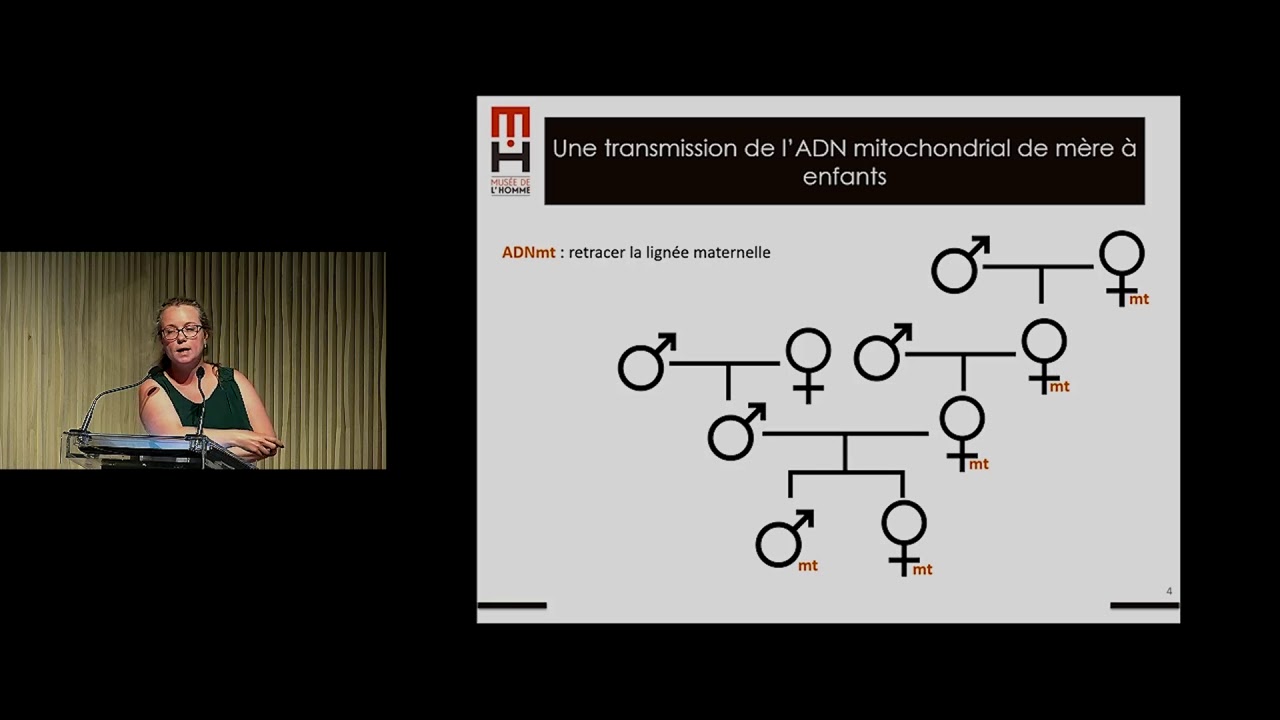
- Explanation of mitochondrial DNA and its maternal inheritance.
- First mitochondrial DNA sequences from Neanderthals and divergence estimates.
- Transition to nuclear DNA and the challenges of contamination.
- Publication of the high-quality Neanderthal genome from the Altai Mountains.
- Discovery of Neanderthal DNA in modern non-African genomes.
- Estimation of interbreeding timing around 50-60,000 years ago.
- Analysis of the Oase 1 fossil and its recent Neanderthal ancestor.
- Identification of Denisovans and their genetic relationship to Neanderthals.
Cited Sources
- Exposition Néandertal — Associated exhibition mentioned in the description.
- Toutes les conférences du Musée de l'Homme — Playlist of lectures from the museum.
Concurring Sources
- Neanderthal genome project — Supports the findings on Neanderthal interbreeding.
Contribution & Novelties
The lecture synthesizes key findings in Neanderthal paleogenetics, providing a clear narrative of how ancient DNA has revolutionized our understanding of human evolution. It emphasizes the evidence for interbreeding and the complexity of hominin relationships.
Pour aller plus loin :
- Neanderthal genome project — Overview of the project and its findings.
- Denisovan — Information on the Denisovan hominins.
- Ancient DNA — General background on the field.
66 words
Radar Profile
The radar profile shows high scores across all dimensions, indicating a well-balanced and informative lecture. The quantity and quality of information are strong, with a good technical level and high reliability.
💬 Sur les 0 commentaires analysés, aucune tendance n'est disponible.