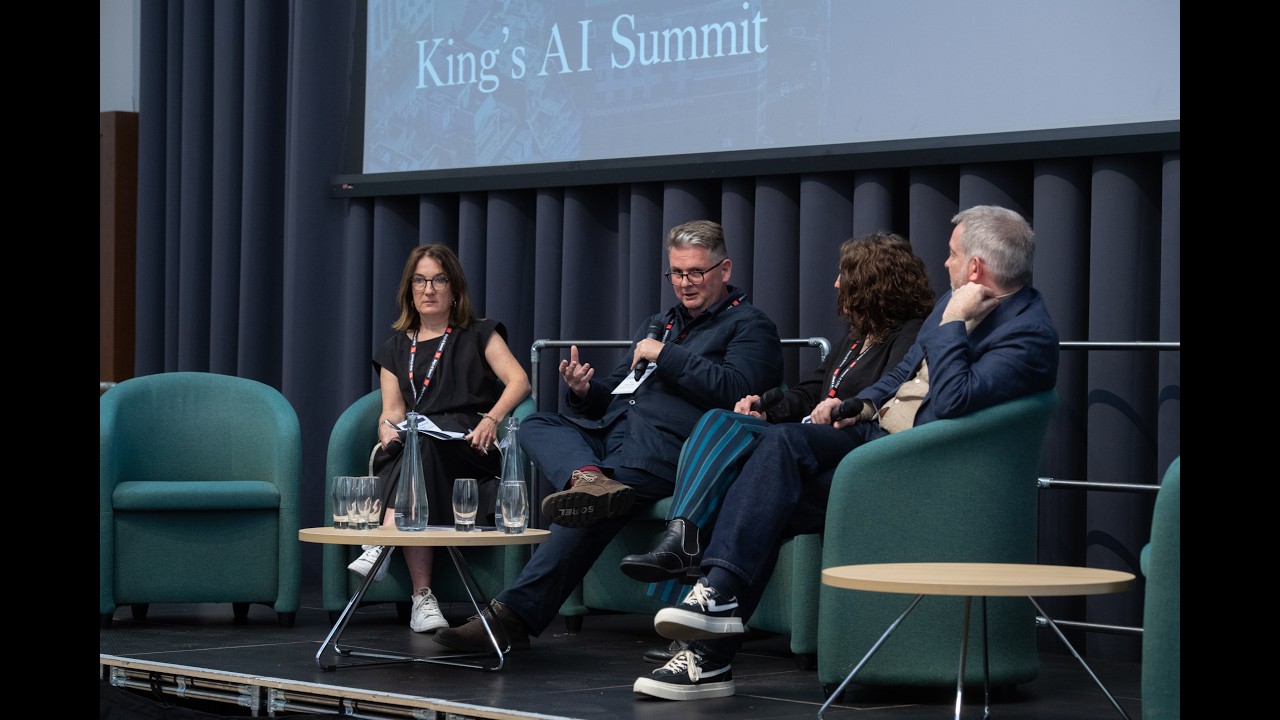
Talent or Tools? What AI Means for a Career in the Creative Industries | King's AI Summit
Keywords
Summary
187 words
Critical Evaluation
Value of the Information & Strength of the Argument
The discussion provides valuable insights from senior leaders in the creative industries, offering a balanced perspective on AI’s impact. The argumentation is solid, grounded in real-world experience and current data. For instance, Nick Poole highlights the economic significance of the UK games industry and the importance of understanding AI’s capabilities beyond coding. Rhodri Talfan Davies articulates the BBC’s cautious approach, emphasizing trust and red lines, while also acknowledging the potential for automation in personalization. The panel effectively argues that human skills like empathy, critical thinking, and contextual intelligence are irreplaceable, and that AI should be seen as a tool to enhance creativity. The discussion also addresses complex issues such as IP and copyright, with Nick Poole providing a nuanced view on the need for a mature conversation about what AI copying means legally. Overall, the argumentation is coherent and well-supported, though it lacks specific data or case studies that could strengthen the points.
Scientific Rigor, Source Quality, Title Accuracy
The panel demonstrates high scientific rigor through the expertise of its speakers, who are directly involved in AI deployment in their respective fields. The discussion is grounded in institutional experience and current industry trends, though specific sources are not cited. The description provides links to the King’s AI Summit website and related resources, which serve as credible references. The title accurately reflects the content, focusing on the debate between talent and tools in the context of AI and creative careers. The discussion is well-structured and stays on topic, with each speaker contributing relevant insights. However, the lack of formal citations or references to specific studies may limit the verifiability of some claims. Overall, the content is reliable and trustworthy, given the authority of the speakers.
293 words
Title / Content Match
The title accurately reflects the central debate on AI's impact on creative careers, balancing talent and tools.
Quality & Reliability
8/10
Panel of senior experts from academia, BBC, and UK games industry; discussion grounded in institutional experience and current data; no formal citations but high credibility of speakers.
Key Moments
Markers derived by PSI from the transcript: the creator did not define chapters.
- Introduction by Professor Abigail Williams, highlighting the economic importance of creative industries.
- Nick Poole discusses the history of AI in video games and the need for new skill sets.
- Sarah Atkinson talks about the impact on entry-level jobs and the ADAPT-AI program.
- Rhodri Talfan Davies explains the BBC's cautious approach and red lines for AI use.
- Discussion on the importance of human skills like empathy and critical thinking.
- Nick Poole discusses the backlash against AI and concerns about job losses and inequality.
- Rhodri Talfan Davies talks about audience expectations and the contextual use of AI.
- Discussion on IP and copyright, with Nick Poole advocating for a nuanced approach.
- Sarah Atkinson explains the ADAPT-AI program's focus on diversifying the workforce.
- Concluding remarks on the need for leadership and responsible AI deployment.
Cited Sources
- King's AI Summit — Official summit website providing context and additional resources.
- AI and Workforce Futures programme — King's College London research programme related to AI and workforce.
- King's AI Summit playlist — Playlist of other summit videos for further viewing.
Concurring Sources
- King's AI Summit — Official summit website providing context and additional resources.
- AI and Workforce Futures programme — King's College London research programme related to AI and workforce.
Contribution & Novelties
This panel provides a timely and authoritative perspective on AI’s impact on creative industries, bringing together leaders from academia, broadcasting, and gaming. It offers a balanced view that avoids both apocalyptic and utopian extremes, emphasizing the need for a nuanced approach. The discussion highlights the importance of human skills that AI cannot replicate, such as empathy and critical thinking, and calls for leadership to navigate the ethical and economic challenges. It also addresses the often-overlooked issue of IP and copyright, advocating for a mature conversation about what AI copying means. The panel’s emphasis on diversifying the workforce through programs like ADAPT-AI is a novel contribution to the discourse.
Pour aller plus loin :
- AI and creativity — Overview of AI’s role in creative processes.
- Copyright and artificial intelligence — Discussion of IP issues in AI.
- Generative AI — Background on the technology behind AI-generated content.
145 words
Radar Profile
The radar profile shows high scores in quality of information and reliability, reflecting the expertise of the panel. The quantity of information is moderate, as the discussion is more qualitative than data-driven. The technical level is moderate, making it accessible to a general audience while still providing depth. Overall, the profile indicates a well-rounded and credible discussion.