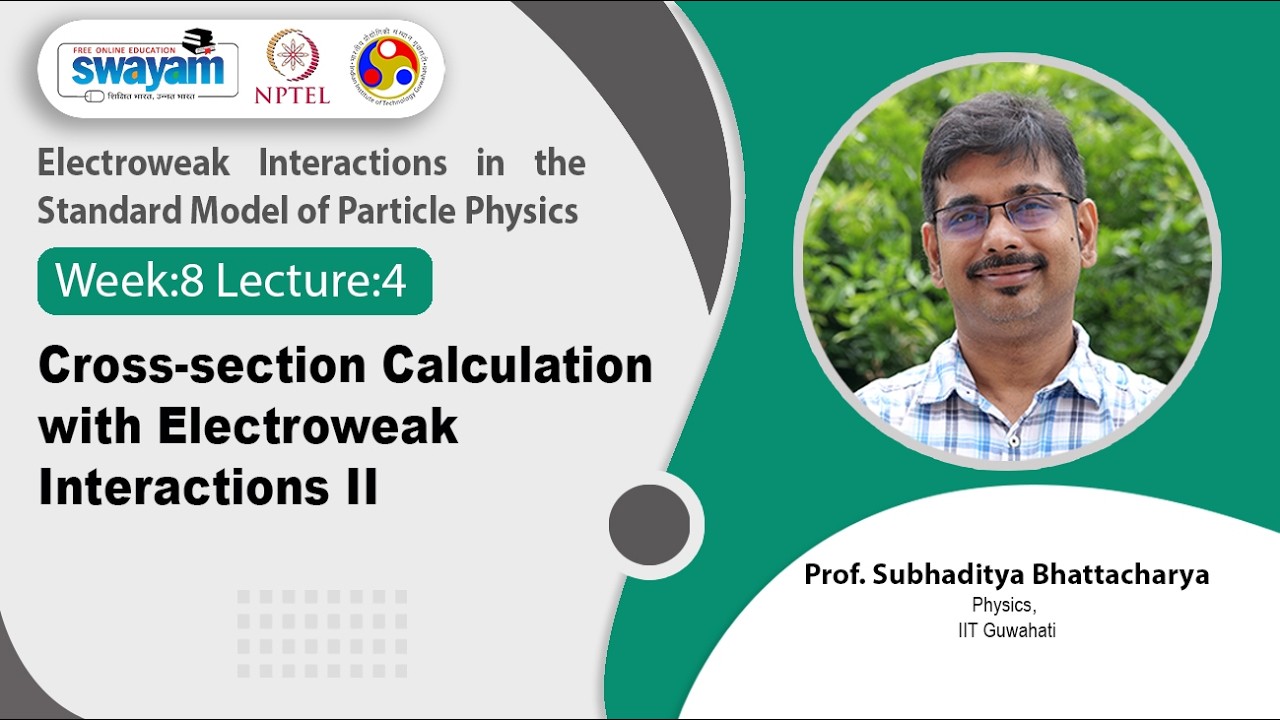
Lec 40: Cross-section calculation with Electroweak Interactions II
Keywords
Summary
129 words
Critical Evaluation
Value of the Information & Strength of the Argument
The lecture provides a detailed and rigorous derivation of the electroweak cross-section, which is valuable for advanced students. The argumentation is logical and follows a clear step-by-step approach, from the matrix element to the final cross-section. The inclusion of the forward-backward asymmetry and the resonance phenomenon demonstrates the predictive power of the theory. The professor also connects the theoretical predictions to experimental observations, strengthening the validity of the presented material.
Scientific Rigor, Source Quality, Title Accuracy
The lecture is scientifically rigorous, based on the Standard Model of particle physics. The derivation is mathematically sound, and the physics is correctly presented. The title accurately reflects the content. The lecture references the experimental discovery of the Z boson, but does not cite specific papers or sources. The course is part of NPTEL, a reputable educational platform, which adds to its credibility.
148 words
Title / Content Match
The title accurately reflects the content, which is a continuation of cross-section calculations including electroweak interference.
Quality & Reliability
8/10
The lecture is a formal derivation of the e+e- → τ+τ- cross-section in the electroweak theory, based on established Standard Model formalism. The physics is correct and the presentation is rigorous, though it is a lecture rather than a peer-reviewed source.
Key Moments
Markers derived by PSI from the transcript: the creator did not define chapters.
- Introduction and recap of the process e+e- → τ+τ-
- Derivation of the interference term between QED and Z-mediated diagrams
- Evaluation of traces and spin sums
- Expression for the full matrix element squared
- Differential cross-section and forward-backward asymmetry
- Discussion of the Z boson resonance and finite width
- Comparison with experimental discovery of Z boson at CERN
Cited Sources
- Course page: Electroweak Interactions in the Standard Model of Particle Physics — Course homepage for the NPTEL course.
- Playlist: Electroweak Interactions — Playlist containing all lectures of the course.
Concurring Sources
- Standard Model — General reference for the Standard Model.
Contribution & Novelties
The lecture provides a complete derivation of the electroweak cross-section for e+e- → τ+τ-, including the interference term and the forward-backward asymmetry. It also explains the finite width of the Z boson and its experimental confirmation. This is a standard topic in particle physics, but the lecture offers a clear pedagogical presentation.
Pour aller plus loin :
- Standard Model — Overview of the Standard Model of particle physics.
- Z boson — Details on the Z boson and its discovery.
- Forward-backward asymmetry — Explanation of the asymmetry in particle physics.
89 words
Radar Profile
The radar profile shows high scores in technical level and information quality, reflecting the advanced and rigorous nature of the lecture. The quantity of information is also high, but the overall reliability is slightly lower due to the lack of cited sources.