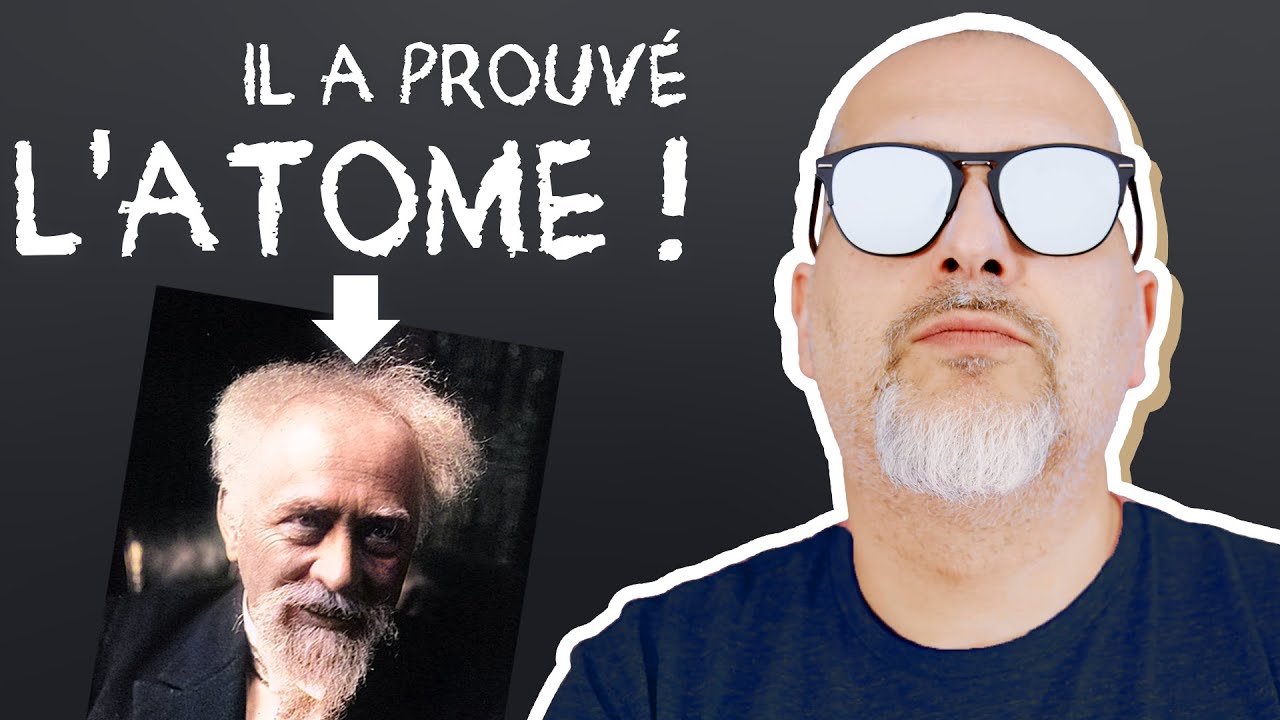
Jean Perrin - Il a mis tout le monde d'accord - LPPV 12
Jean Perrin - He brought everyone to agreement - LPPV 12
Keywords
Summary
126 words
Critical Evaluation
Value of the Information & Strength of the Argument
The video provides substantial value by presenting a comprehensive and engaging narrative of Jean Perrin’s scientific contributions and their historical context. The argumentation is solid, as it is based on primary sources and historical records. The presenter clearly explains complex scientific concepts, such as Brownian motion and the Avogadro constant, making them accessible to a general audience. The logical progression from Perrin’s early work to his definitive experiments is well-structured and convincing. The video also effectively argues for the importance of Perrin’s political legacy, particularly his role in founding the CNRS, which is often overlooked.
Scientific Rigor, Source Quality, Title Accuracy
The video demonstrates high scientific rigor by referencing original publications and historical documents, such as Perrin’s articles and the proceedings of the Solvay Conference. The sources are credible and directly relevant to the content. The title accurately reflects the video’s focus on Perrin’s role in unifying the scientific community around atomic theory. The video also includes a brief mention of the Dreyfus affair, which is historically accurate and adds context to Perrin’s life. Overall, the sources are well-chosen and the title is appropriate.
193 words
Title / Content Match
The title accurately reflects the content: the video focuses on Jean Perrin's scientific achievements and his role in establishing the reality of atoms.
Quality & Reliability
8/10
The video is well-researched, referencing primary sources and historical documents. The presenter is known for rigorous science communication. Minor inaccuracies or simplifications are possible but overall reliable.
Chapters
- Intro
- Etudes
- L'affaire Dreyfus
- Les proches de Perrin
- A propos de Marie Curie
- Sur le mouvement brownien
- Introduction au nombre d'Avogadro
- Sur la diffusion de Rayleigh
- Le congrès où Perrin plie le game
- Détermination du nombre d'Avogadro
- La vie politique de Perrin
- Jean Zay
- Organisation de la recherche pendant la guerre
- Naissance du CNRS
- Un peu plus sur Jean Zay
- Louis Rapkine
- Inauguration de l'école libre des hautes études de New York par Perrin
- Décès de Perrin et conclusion
- Conclusion de la vidéo
- Outro et générique de fin
Cited Sources
- Mouvement brownien et réalité moléculaire (Wikisource) — Original article by Jean Perrin (1909) on Brownian motion and molecular reality.
- Les Atomes (Wikisource) — Extract from Perrin's book 'Les Atomes' discussing Van der Waals and Avogadro's number.
- Mouvement brownien et réalité moléculaire (HAL) — Original version of Perrin's article on Brownian motion and molecular reality.
- Les preuves de la réalité moléculaire (Collège de France) — Perrin's conference text presented at the 1911 Solvay Congress.
- Nota Bene video on Dreyfus — Referenced for more details on the Dreyfus affair.
- L'atome, partie 1 (e-penser) — Related video on atoms.
- Relativité restreinte, partie 1 (e-penser) — Related video on special relativity, mentioning Einstein's Brownian motion paper.
Concurring Sources
- Jean Perrin - Wikipedia — Provides biographical information consistent with the video.
- Brownian motion - Wikipedia — Confirms the scientific details of Brownian motion.
- Avogadro constant - Wikipedia — Confirms the value and significance of Avogadro's number.
External References
Contribution & Novelties
The video provides a comprehensive and engaging overview of Jean Perrin’s life and work, highlighting his crucial role in establishing atomic theory. It brings together scientific and historical aspects, offering a unique perspective on how Perrin’s experiments and political actions shaped modern science. The video also emphasizes the importance of his determination of Avogadro’s number and his involvement in the creation of the CNRS.
Pour aller plus loin :
- Brownian motion - Wikipedia — For a detailed explanation of the phenomenon.
- Avogadro constant - Wikipedia — For more on the constant and its determination.
- Solvay Conference - Wikipedia — For context on the conference where Perrin presented his work.
- Jean Perrin - Wikipedia — For a biographical overview.
- CNRS - Wikipedia — For information on the French national research center founded with Perrin’s involvement.
134 words
Radar Profile
The radar profile shows high scores in information quantity and quality, indicating a content-rich and reliable video. The technical level is moderate, making it accessible to a broad audience while still providing depth. Overall, the video is well-balanced and highly informative.
💬 Très positif. Les commentaires expriment un fort enthousiasme pour la vidéo, saluant à la fois le fond scientifique et la forme humoristique, avec de nombreuses références aux blagues internes et aux génériques.