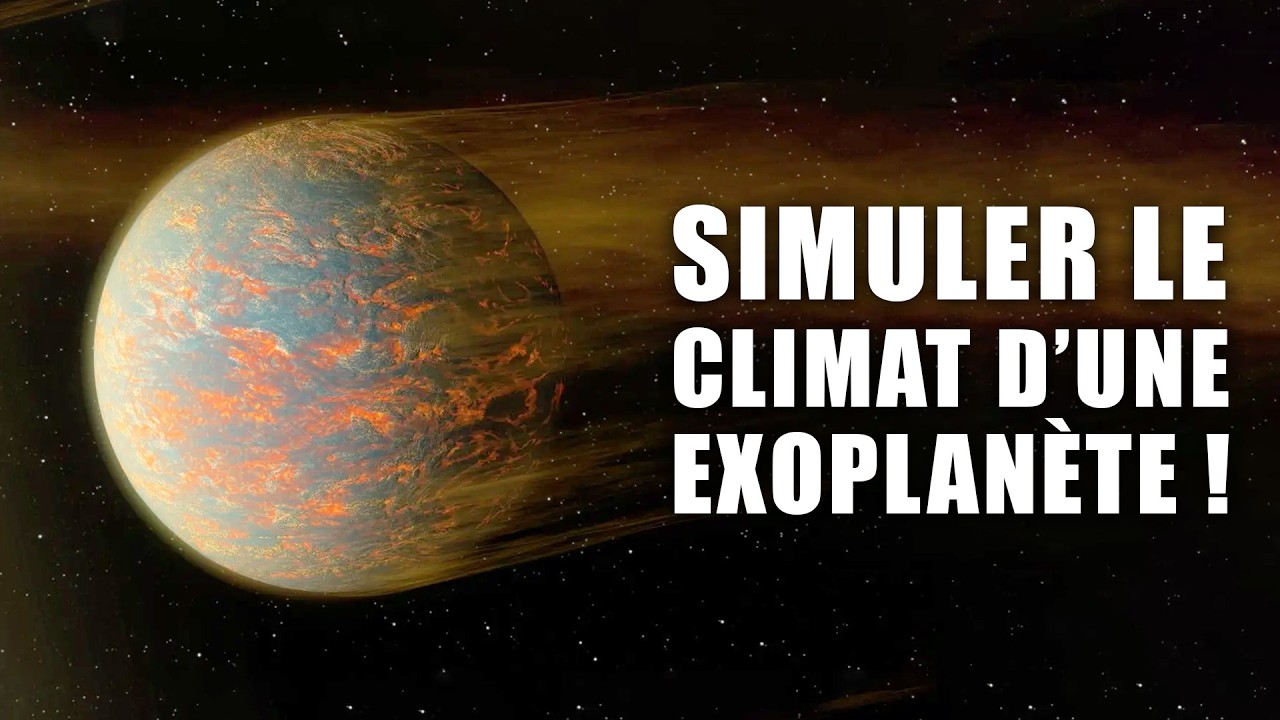
Explorer les exoplanètes avec un supercalculateur !
Exploring exoplanets with a supercomputer!
Keywords
Summary
193 words
Critical Evaluation
Value of the Information & Strength of the Argument
The video provides valuable insights into the methodology of exoplanet atmospheric modeling, a topic often overlooked in popular science. It clearly explains the progression from simple to complex models, using concrete examples like TRAPPIST-1c and K2-18b to illustrate the strengths and limitations of each approach. The argumentation is solid, presenting both the successes and the uncertainties, such as the degeneracy problem, which demonstrates a balanced and critical perspective. The presenter effectively communicates the importance of models in guiding observations and interpreting data, making the content both informative and thought-provoking.
Scientific Rigor, Source Quality, Title Accuracy
The video demonstrates strong scientific rigor by referencing specific studies and models, such as the 2023 TRAPPIST-1c study and the 2024 GCM follow-up. The sources cited in the description (NASA’s Planetary Spectrum Generator, an arXiv paper, and a HAL document) are reputable and directly relevant. The title accurately reflects the content, focusing on the use of computational models to explore exoplanets. The presenter also acknowledges the limitations of models and the need for assumptions, which adds to the credibility. The video does not overstate findings, consistently using conditional language when discussing potential discoveries.
197 words
Title / Content Match
The title accurately reflects the content, which focuses on using computational models to explore and characterize exoplanets.
Quality & Reliability
8/10
The video presents a well-structured overview of exoplanet atmospheric modeling, referencing specific studies and models. The scientific content is accurate and up-to-date, with clear explanations of model types and their applications. The presenter acknowledges uncertainties and limitations appropriately. The sources cited are reputable (NASA, arXiv, HAL).
Key Moments
Markers derived by PSI from the transcript: the creator did not define chapters.
- Introduction to exoplanet discoveries and the role of models
- Explanation of what models are and their limitations
- Introduction to 0D models and equilibrium temperature calculation
- Transition to 1D models and their applications
- Case study of TRAPPIST-1c using 1D models
- Discussion of 2D and 3D GCM models
- Example of GCM application to TRAPPIST-1c and the degeneracy problem with K2-18b
- Future prospects and conclusion
Cited Sources
- Planetary Spectrum Generator (PSG) — NASA tool for modeling planetary spectra, used in the video to illustrate atmospheric modeling.
- HAL document (hal-04087631) — Scientific paper likely related to exoplanet atmospheric modeling, cited as a source.
- arXiv paper (2306.10150) — Research paper on exoplanet atmospheres, likely the 2023 TRAPPIST-1c study.
Concurring Sources
- NASA Exoplanet Archive — A comprehensive database of exoplanet data, consistent with the video's discussion of observational data.
Dissenting Sources
- Alternative interpretation of K2-18b observations — A paper proposing a magma ocean scenario for K2-18b, contrasting with the hycean model discussed in the video.
External References
Contribution & Novelties
The video offers a clear and accessible explanation of the hierarchy of exoplanet atmospheric models, from 0D to 3D GCMs, and their role in interpreting observations. It highlights the iterative process between modeling and observation, and the challenges of model degeneracy. This is a valuable contribution to science communication, as it demystifies a complex topic.
Pour aller plus loin :
- Global Circulation Model — Wikipedia article explaining GCMs, relevant to the 3D models discussed.
- TRAPPIST-1 — Wikipedia page on the TRAPPIST-1 system, providing context for the case studies.
- James Webb Space Telescope — Wikipedia article on JWST, the telescope used for the observations mentioned.
104 words
Radar Profile
The radar profile shows high scores in information quality and reliability, with slightly lower scores in technical depth and quantity. This indicates a well-balanced video that is both informative and accessible, with a strong emphasis on accurate scientific content.
💬 Très positif. Sur les 30 commentaires analysés, tous expriment une appréciation très positive, saluant la qualité, la profondeur et l'accessibilité du contenu, ainsi que le travail de recherche effectué.