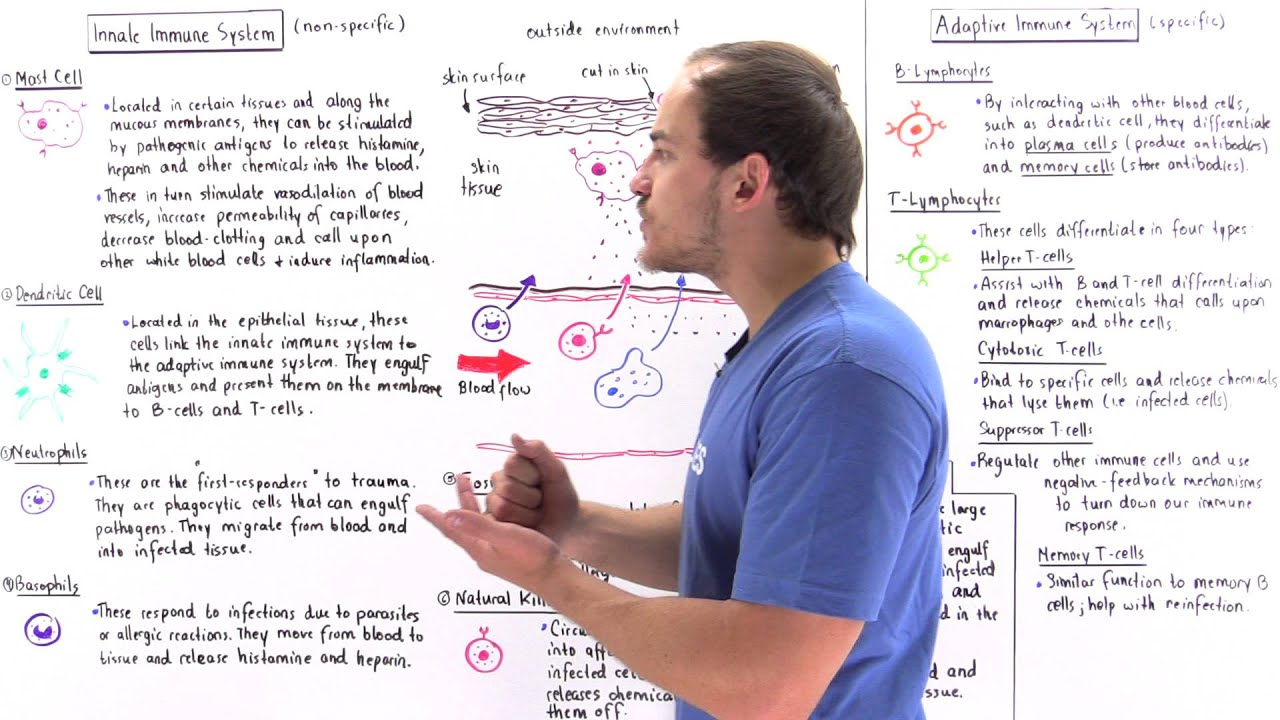
Innate and Adaptive Immune Systems
Keywords
Summary
153 words
Critical Evaluation
Value of the Information & Strength of the Argument
The video offers a valuable educational resource for understanding the fundamental concepts of immunology. It clearly explains the roles of key cells and molecules, using a logical narrative that builds from an initial infection scenario. The argumentation is solid, as it systematically describes each component and its function, and effectively illustrates the connection between innate and adaptive immunity. However, it lacks critical analysis or discussion of experimental evidence, and it simplifies some complex processes, which may be acceptable for an introductory audience but limits its depth for advanced learners.
Scientific Rigor, Source Quality, Title Accuracy
The scientific content is accurate and aligns with established immunology knowledge. The video does not cite specific sources, but it is consistent with standard textbook material. The title accurately reflects the content. The description provides links to the lecturer’s website, which may contain additional resources, but no direct references to primary literature are given. The presentation is clear and well-structured, with diagrams that aid understanding. Overall, the scientific rigor is adequate for an introductory overview, but the lack of citations reduces its value for those seeking to verify claims or explore further.
196 words
Title / Content Match
The title accurately reflects the content, which focuses on the interaction and components of the innate and adaptive immune systems.
Quality & Reliability
8/10
The video provides a clear and accurate overview of the innate and adaptive immune systems, with correct terminology and logical flow. However, it lacks citations to primary literature and does not address recent advances or nuances, limiting its depth for advanced learners.
Key Moments
Markers derived by PSI from the transcript: the creator did not define chapters.
- Introduction to the scenario of a skin cut and pathogen invasion.
- Mast cells release histamines, heparin, and cytokines, initiating inflammation.
- Dendritic cells engulf antigens, process them, and present them on MHC.
- Granulocytes (neutrophils, basophils, eosinophils) respond to infection.
- Natural killer cells destroy infected cells and cancer cells.
- Macrophages engulf pathogens and debris.
- Adaptive immune response: B cells differentiate into plasma cells and memory B cells.
- T cells: helper, cytotoxic, suppressor, and memory T cells and their functions.
Cited Sources
- AK Lectures — Website of the lecturer, providing additional resources.
- Donate page — Support page for the channel.
- Lecture page — Direct link to the lecture on the website.
Concurring Sources
- Innate immune system — Wikipedia article providing general information on innate immunity.
- Adaptive immune system — Wikipedia article providing general information on adaptive immunity.
Contribution & Novelties
The video provides a clear and concise synthesis of the innate and adaptive immune systems, emphasizing their interaction. It is particularly useful for beginners as it simplifies complex concepts without oversimplifying. The original contribution lies in its pedagogical approach, using a single scenario to illustrate the entire immune response.
Pour aller plus loin :
- Innate immune system — Overview of innate immunity.
- Adaptive immune system — Overview of adaptive immunity.
- Antigen presentation — Process of antigen presentation by dendritic cells.
80 words
Radar Profile
The radar profile shows high scores in quality and reliability, with moderate scores in quantity and technical level. This indicates a well-structured and accurate overview, but with limited depth and breadth, suitable for introductory learning.
💬 Sur les 0 commentaires analysés, aucune tendance n'est disponible.