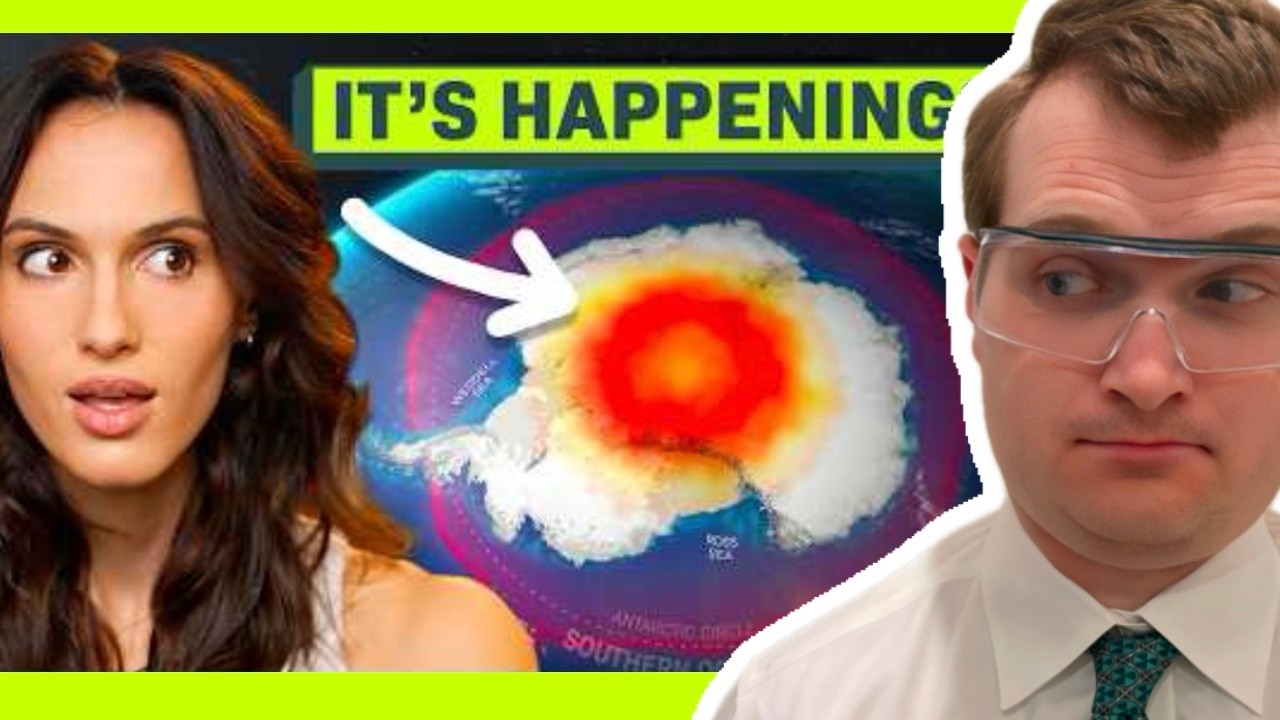
Something is Happening to the Antarctic Ozone Hole - Nuclear Engineer Reacts to Cleo Abram
Keywords
Summary
145 words
Critical Evaluation
Value of the Information & Strength of the Argument
The video’s value lies in its dual perspective: it presents the original documentary’s compelling narrative of a global environmental crisis averted, while the reactor adds a layer of expert analysis that both reinforces and refines the scientific claims. The argumentation is generally solid, as the reactor correctly identifies the catalytic role of chlorine radicals in ozone destruction and the importance of polar stratospheric clouds. He also appropriately cautions against taking model-based predictions of an alternate timeline too literally, noting that such extrapolations are highly dependent on underlying assumptions. However, the reactor’s arguments are sometimes based on analogies to nuclear engineering, which, while illustrative, may not always perfectly map to atmospheric science. The discussion of ocean circulation and the ‘heartbeat of the planet’ metaphor is a point where the reactor’s pushback is valid but could be seen as overly pedantic. Overall, the value is high for viewers seeking a scientifically informed reaction to a popular science video, but the argumentation is not without its minor over-simplifications.
Scientific Rigor, Source Quality, Title Accuracy
The reactor demonstrates a good level of scientific rigor by providing accurate explanations of the chemical processes involved in ozone depletion and the physical mechanisms behind Antarctic winds and ocean currents. He correctly emphasizes the importance of long-term data collection, as exemplified by the 30 years of ozone measurements that were crucial for identifying the hole. The primary source cited is the original video by Cleo Abram, which is appropriate for a reaction video. The reactor does not introduce external sources, but his commentary is consistent with established scientific consensus. The title accurately reflects the content, as the video is indeed a reaction to the mentioned documentary. The reactor’s own expertise in nuclear engineering lends credibility to his broader points about complex systems and the importance of monitoring, though it is not a substitute for atmospheric science expertise.
318 words
Title / Content Match
The title accurately reflects the content: the reactor analyzes Cleo Abram's video about the Antarctic ozone hole, providing his expert reactions and corrections.
Quality & Reliability
7/10
The reactor provides a generally accurate and well-contextualized explanation of the ozone hole science, the Montreal Protocol, and the Antarctic Treaty, while offering appropriate caveats about model-based extrapolations. However, the video is a reaction/opinion piece, not a primary scientific source, and the reactor's expertise is in nuclear engineering, not atmospheric science, which limits the depth of verification.
Key Moments
Markers derived by PSI from the transcript: the creator did not define chapters.
- Introduction to the topic and the original video by Cleo Abram.
- Discussion of the ozone hole and the alternate timeline scenario, with the reactor cautioning about model extrapolations.
- Explanation of UV radiation and its effects, and the role of the ozone layer as a 'sunscreen'.
- Commentary on the perception of risk and the 'boring' nature of successful environmental regulations.
- Description of the journey to Antarctica and the challenges of the Drake Passage.
- Discussion of the Antarctic Treaty and the International Geophysical Year.
- Explanation of the role of Antarctica in global ocean currents and climate.
- The discovery of the ozone hole and the work of Susan Solomon's team.
- The Montreal Protocol and the global ban on CFCs.
- Conclusion on the success story and the importance of international cooperation.
Cited Sources
- Original video by Cleo Abram — The video being reacted to, which covers the Antarctic ozone hole and its history.
Concurring Sources
- NASA Ozone Watch — Provides current data and information on the ozone layer, consistent with the video's claims about recovery.
Contribution & Novelties
The video’s original contribution is the reactor’s expert commentary, which adds a layer of technical nuance to the popular science narrative. He provides a more rigorous explanation of the chemistry of ozone depletion, the physics of Antarctic winds, and the complexity of Earth’s climate system. The reactor also draws insightful parallels to nuclear engineering, emphasizing the importance of continuous monitoring and the dangers of oversimplification. This perspective is valuable for viewers seeking a deeper understanding of the science behind the headlines.
Pour aller plus loin :
- Montreal Protocol — The international treaty that successfully phased out ozone-depleting substances.
- Ozone depletion — The scientific phenomenon and its causes.
- Antarctic Treaty System — The international agreement governing Antarctica.
- International Geophysical Year — The 1957-58 collaborative scientific effort that laid the groundwork for Antarctic research.
- Susan Solomon — The scientist who led the team that identified CFCs as the cause of the ozone hole.
151 words
Radar Profile
The radar profile shows a balanced video with high scores in information quality and technical level, reflecting the reactor's expertise. The quantity of information is moderate, as the video is a reaction rather than a comprehensive documentary. The overall reliability is good, but the subjective nature of the commentary prevents a perfect score.
💬 Sur les 0 commentaires analysés, aucune tendance n'est disponible.