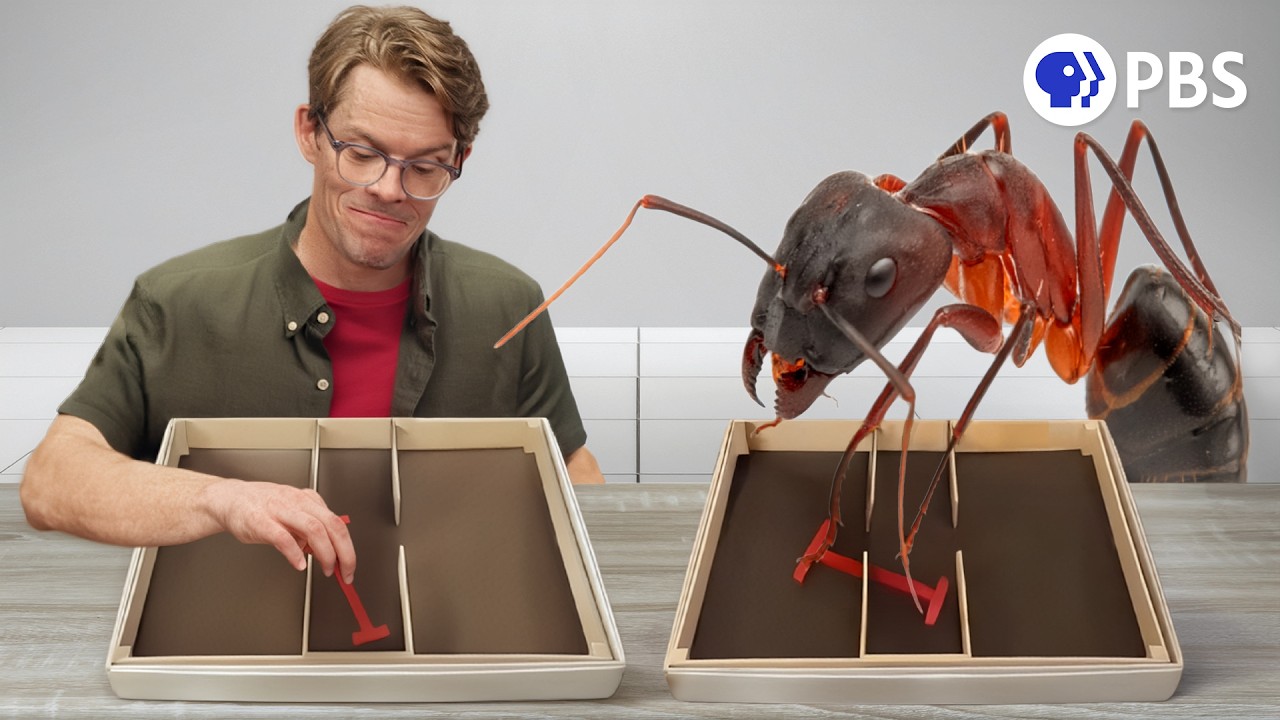
The Intelligence Test Where Ants Beat Humans
Keywords
Summary
167 words
Critical Evaluation
Value of the Information & Strength of the Argument
The video provides valuable information by presenting a clear and engaging explanation of swarm intelligence, a concept that challenges traditional views of intelligence. It effectively uses the piano mover’s problem as a concrete example to illustrate the phenomenon. The argumentation is solid, building from historical context (Aristotle, Huber) to modern computational models (Reynolds’ BOIDs) and recent research (Garnier’s army ant studies). The explanation of the four simple rules that govern ant bridge-building is particularly compelling and well-illustrated. The video also connects the concept to broader applications, such as traffic engineering and robotics, demonstrating its practical relevance. The scientific content is accurate and well-sourced, with references provided in the description.
Scientific Rigor, Source Quality, Title Accuracy
The video demonstrates strong scientific rigor by referencing specific researchers and their work, including Craig Reynolds’ 1987 BOIDs simulation and Simon Garnier’s studies on army ants. The description includes a link to a references page, which adds credibility. The title accurately reflects the content, which is a comparison of ant and human problem-solving abilities. The video is well-produced and clearly distinguishes between established facts and hypotheses. The inclusion of a sponsorship segment (AnyDesk) is clearly marked and does not detract from the scientific content. The comments section shows a generally positive reception, with viewers engaging critically with the content, though some point out potential unfairness in the human-ant comparison due to communication differences.
237 words
Title / Content Match
The title accurately reflects the video's central theme: a comparison of problem-solving abilities between ants and humans, highlighting the surprising collective intelligence of ants.
Quality & Reliability
8/10
The video presents established scientific concepts (swarm intelligence, emergent behavior) with references to specific studies and researchers (Craig Reynolds, Simon Garnier). The content is well-structured and aligns with current scientific understanding, though it simplifies some nuances for a general audience.
Chapters
Cited Sources
- References for Collective Intelligence — The video description provides this link as a source for the scientific references cited in the video.
- Be Smart official website — The video description includes this link as the official website for the show.
- Stated Clearly — The video description mentions this as the work of writer/producer Jon Perry.
Concurring Sources
- Swarm intelligence (Wikipedia) — The video's content aligns with the general scientific consensus on swarm intelligence as described in this Wikipedia article.
- Emergence (Wikipedia) — The video's explanation of how simple rules lead to complex group behavior is consistent with the concept of emergence.
Contribution & Novelties
The video offers a fresh and accessible perspective on swarm intelligence, making complex scientific concepts understandable to a broad audience. It effectively combines historical context, modern research, and practical applications, providing a comprehensive overview. The use of the piano mover’s problem as a central example is particularly effective in illustrating the counterintuitive nature of collective intelligence.
Pour aller plus loin :
- Swarm intelligence (Wikipedia) — Provides a comprehensive overview of the field, including definitions, examples, and applications.
- Emergence (Wikipedia) — Explains the concept of emergent behavior, which is central to understanding how simple rules can lead to complex group behaviors.
- Craig Reynolds’ BOIDs page — The original source for the BOIDs simulation, offering detailed information and interactive demos.
- Army ant (Wikipedia) — Provides background on the biology and behavior of army ants, the species featured in the video.
138 words
Radar Profile
The radar profile shows a well-rounded video with high scores across all dimensions, indicating strong information quality, technical depth, and reliability. The slightly lower score on quantity of information reflects the video's focus on a specific topic rather than a broad survey.
💬 Positif. Sur les 30 commentaires analysés, le public exprime un intérêt marqué pour le sujet, avec des discussions critiques sur la comparaison entre humains et fourmis, notamment sur les différences de communication, et des références culturelles (ex. 'Pivot' de Friends).