Lecture 20 for MIT 6.832 (Underactuated Robotics)
Keywords
Summary
200 words
Critical Evaluation
Value of the Information & Strength of the Argument
The lecture provides a solid foundation for understanding stochastic dynamics in control systems. It clearly explains the mathematical framework for propagating probability distributions through linear and nonlinear systems, using intuitive examples like the particle in a bowl and the rimless wheel. The argumentation is logical and builds from simple to complex cases, making the material accessible despite its technical depth. The value lies in its pedagogical clarity and the connection to real robotic applications, particularly the rimless wheel example which effectively motivates the need for stochastic analysis in legged locomotion.
Scientific Rigor, Source Quality, Title Accuracy
The lecture is scientifically rigorous, presenting derivations and equations with precision. It references standard concepts like the Kalman filter and master equation, but does not cite specific external sources. The title accurately reflects the content, which is a lecture on stochastic systems within the context of underactuated robotics. The absence of citations is typical for a lecture, but the academic provenance (MIT) and the clarity of the presentation support its reliability. No comments were provided for analysis.
182 words
Title / Content Match
The title accurately describes the content: a lecture on stochastic systems within the Underactuated Robotics course.
Quality & Reliability
8/10
Lecture from MIT's Underactuated Robotics course, presented by an expert (likely Russ Tedrake). Content is mathematically rigorous, well-structured, and builds on established theory (stochastic processes, Kalman filter). No citations provided, but the academic context and clear derivations support high reliability.
Key Moments
Markers derived by PSI from the transcript: the creator did not define chapters.
- Introduction to stochastic systems and process noise.
- Formal definition of stochastic dynamics and distinction from measurement noise.
- Simple example: particle in a bowl with Brownian motion, linear Gaussian case.
- Derivation of probability distribution dynamics and stationary distribution.
- Extension to nonlinear systems, double-well potential, and escape attempts.
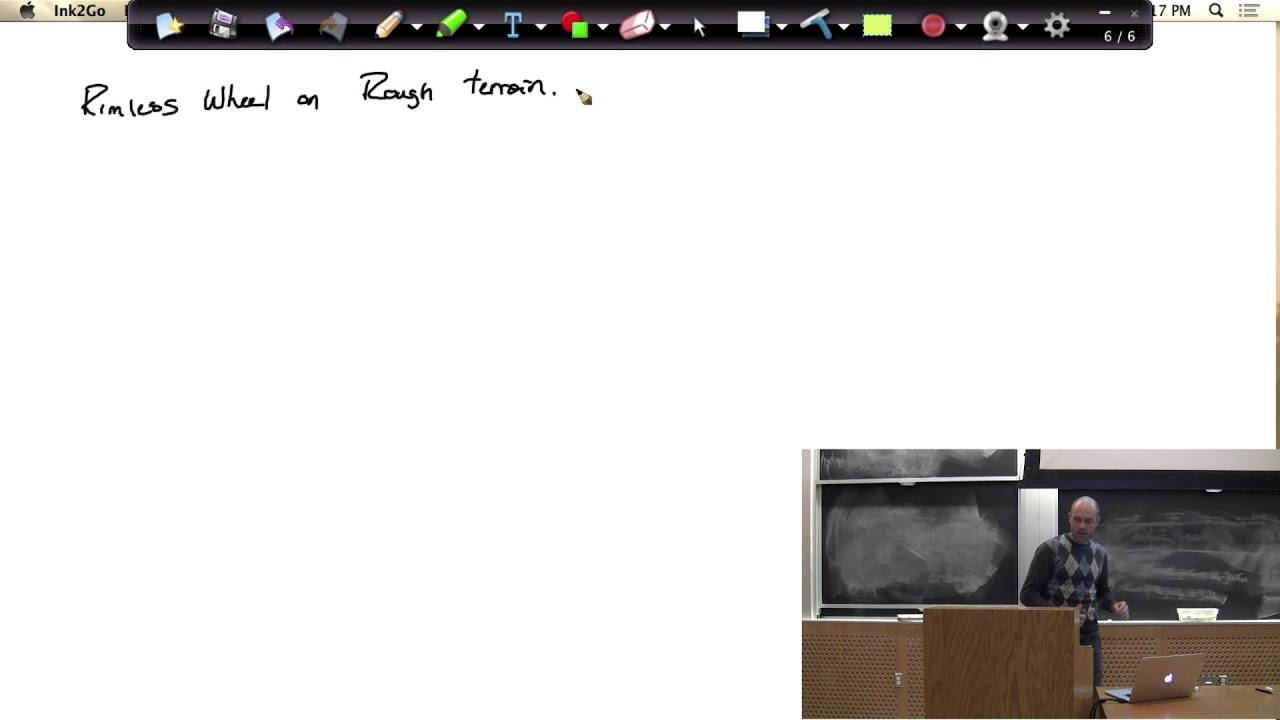
- Introduction to the rimless wheel on rough terrain as a stochastic example.
- Discussion of the apex-to-apex return map and its stochastic version.
Contribution & Novelties
This lecture provides a clear and accessible introduction to stochastic control, emphasizing the propagation of uncertainty through dynamical systems. It bridges the gap between deterministic control and stochastic processes, offering both theoretical foundations and practical examples. The rimless wheel example is particularly valuable for illustrating how stochastic analysis applies to legged robotics.
Pour aller plus loin :
- Kalman filter — The linear Gaussian propagation discussed is a special case of the Kalman filter without measurements.
- Master equation — The dynamics of the probability distribution in nonlinear systems are described by the master equation.
- Stochastic differential equation — The continuous-time version of the stochastic dynamics introduced in this lecture.
- Rimless wheel — A classic model in legged locomotion, used here to illustrate stochastic terrain.
123 words
Radar Profile
The radar profile shows high scores in quality and technical level, with slightly lower scores in quantity and reliability. This reflects a lecture that is dense and well-explained but lacks external citations and covers a limited scope within the time.