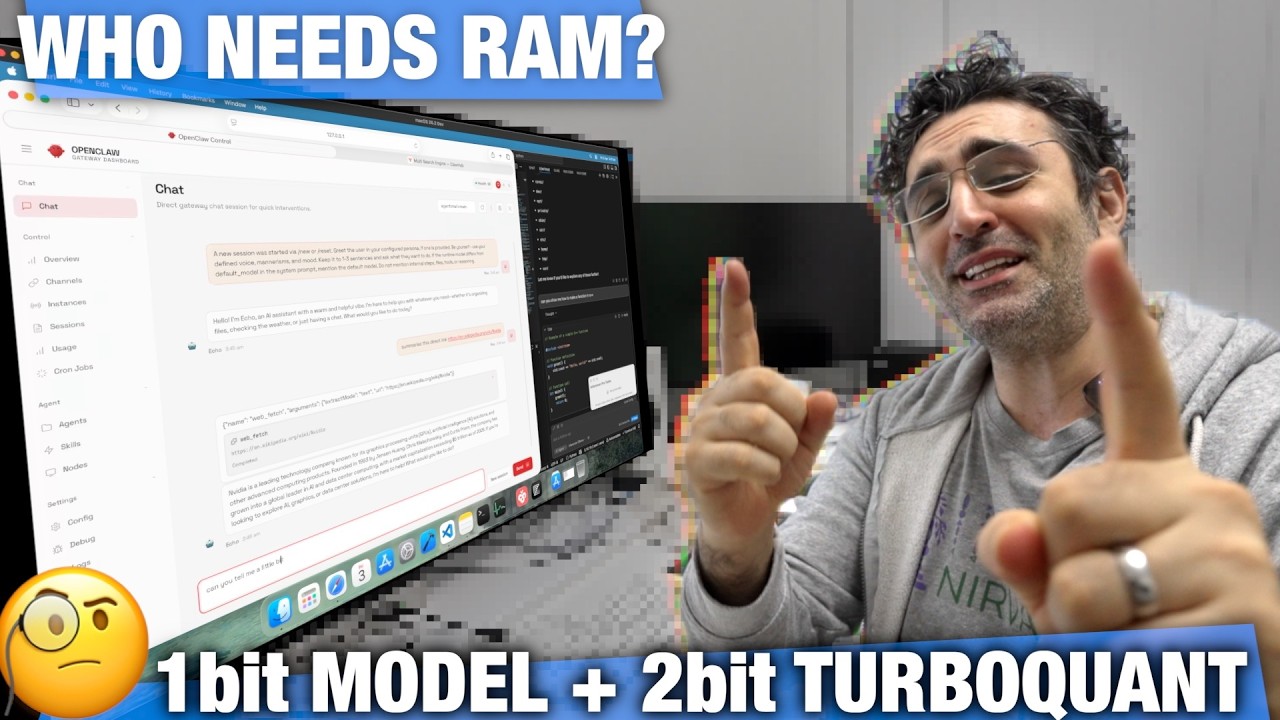
Bonsai 1bit Local AI Model + 2bit TurboQuant - Will it Run OpenClaw? 🤯
Keywords
Summary
201 words
Critical Evaluation
Value of the Information & Strength of the Argument
The video offers valuable insights into the practical performance of extreme low-bit quantization in AI models. It demonstrates that even with 1-bit weights, the model can exhibit surprising coherence and handle basic tool calls and logical reasoning. The creator’s argumentation is based on hands-on testing, showcasing real examples of successes and failures. However, the tests are not standardized, and the results are anecdotal. The video does not provide benchmarks against other models with rigorous metrics, but it does give useful data on token generation speed and memory usage. The claim that the model is ‘insanely smarter’ than others is supported by some qualitative comparisons, but it is not substantiated with quantitative evidence. Overall, the video effectively presents the potential of such models while acknowledging their limitations.
Scientific Rigor, Source Quality, Title Accuracy
The scientific rigor is moderate. The creator provides links to the model’s HuggingFace page and the Inferencer tool, which are legitimate sources. However, the video does not delve into the underlying research paper or technical details beyond a brief mention. The title adequately reflects the content, with a minor emphasis on OpenClaw, which is indeed a significant part of the demonstration. The creator does not cite external scientific literature, relying on his own tests. The quality of sources is acceptable for a YouTube demonstration, but not at a level suitable for academic reference. The video’s conclusions are presented as opinions based on personal experience, which is clearly stated.
249 words
Title / Content Match
The title accurately reflects the content: the video tests the Bonsai 1-bit model combined with 2-bit TurboQuant, and specifically checks if it can run OpenClaw. Minor mismatch: the OpenClaw part is only a portion of the video, but it's a key highlight.
Quality & Reliability
6/10
The video provides a hands-on demonstration of a 1-bit quantized AI model, but the tests are informal and not benchmarked. The creator tests tool calling, logic, and coding tasks, but results are subjective and occasional hallucinations are noted. Performance metrics are given (tokens/sec, memory usage) but without rigorous methodology.
Key Moments
Markers derived by PSI from the transcript: the creator did not define chapters.
- Introduction of Bonsai 1-bit model and explanation of quantization
- Tool call test on x-ray.com with 8-bit model
- Logic tests including car wash and surgeon riddle
- Coding test showing failures on complex projects but success on simple snippets
- Integration with OpenClaw and demonstration of multiple simultaneous requests
Cited Sources
- HuggingFace - inferencerlabs — Model repository for Bonsai and other quantized models
- ModelScope - inferencerlabs — Alternative model hosting
- Inferencer App — Application used to run the models
- TurboQuant video — Companion video explaining TurboQuant
- Model Streaming video — Related video on model streaming
External References
Contribution & Novelties
The video showcases the first practical demonstration of a 1-bit quantized LLM running on consumer hardware with reasonable performance. It highlights that extreme quantization can retain surprising capabilities, especially in logical reasoning and tool usage. The integration with OpenClaw shows potential for agentic AI on edge devices.
Pour aller plus loin :
- Quantization (signal processing) — Overview of quantization techniques.
- Edge computing — Related concept for deploying AI on local devices.
- Mixed-precision arithmetic — Discusses various levels of numerical precision.
80 words
Radar Profile
The scores indicate a high quantity of information and technical level, but moderate quality and reliability. This reflects the video's strength in demonstrating many aspects but its weakness in providing rigorous evidence.