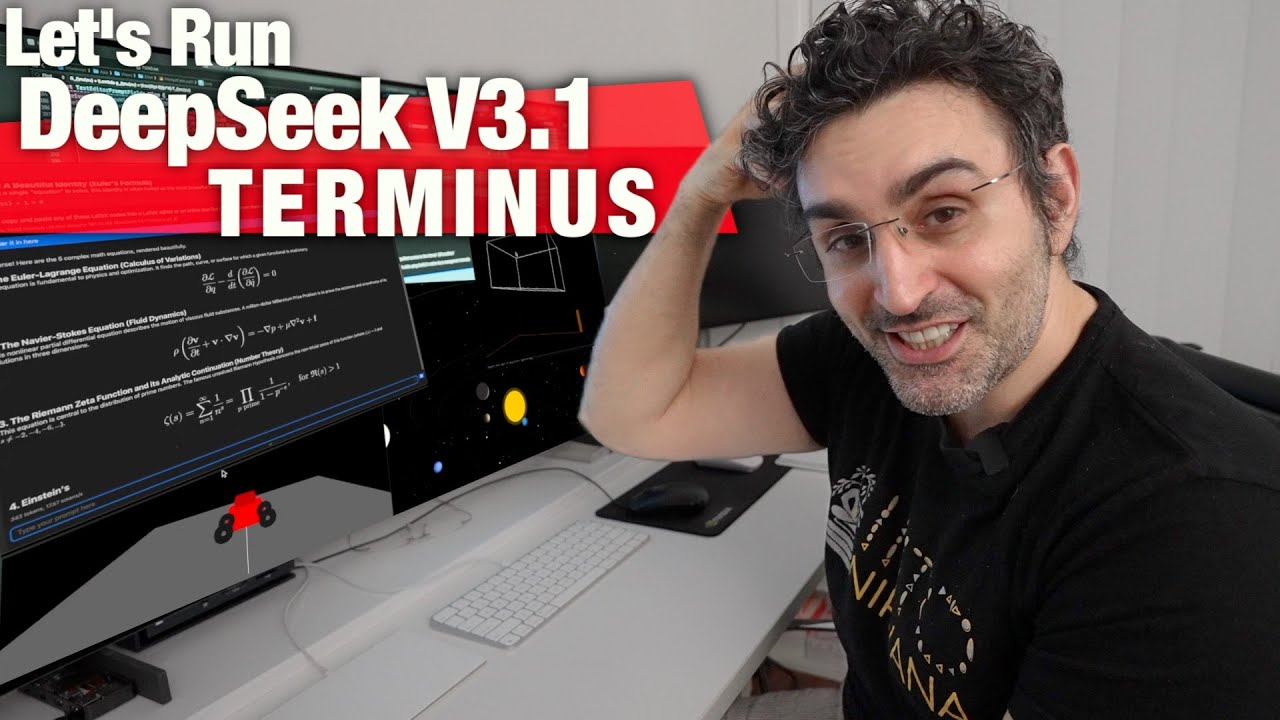
Let's Run DeepSeek V3.1-TERMINUS Local AI | Developer Review
Keywords
Summary
123 words
Critical Evaluation
Value of the Information & Strength of the Argument
The value lies in the practical, hands-on comparison of different quantizations of a large model on high-end Apple hardware, offering real performance numbers (tokens per second) and qualitative observations. The argumentation is supported by concrete examples, but it is limited by the lack of statistical rigor: each test is run only once, no control conditions are set, and the evaluation is subjective. The reasoning about entropy provides an interesting insight into model confidence but is not integrated into a systematic assessment.
Scientific Rigor, Source Quality, Title Accuracy
The video cites the Hugging Face repository for the MLX quantized model and the Inferencer app, as well as companion video reviews. However, it does not reference official DeepSeek papers or independent benchmarks. The title accurately matches the content, and the adequacy is excellent. The methodology is informal, and the conclusions are presented as personal observations rather than reproducible experiments.
156 words
Title / Content Match
The title accurately reflects the content: the reviewer runs DeepSeek V3.1-Terminus locally and provides a developer-focused evaluation, including performance comparisons between quantizations.
Quality & Reliability
6/10
The video provides hands-on testing of the model but with a small, non-replicated sample and no rigorous methodology. The conclusions are based on personal observation and a few coding tests, making the reliability moderate at best.
Key Moments
Markers derived by PSI from the transcript: the creator did not define chapters.
- Introduction to DeepSeek V3.1-Terminus and overview of quant sizes (Q5 and Q4/6 mix).
- First test: reasoning riddle about surgeon and boy's father; both quants answer 'mother' with high confidence.
- HTML/JavaScript code generation for a 3D solar system; Q5 runs, Q4/6 fails due to 'orbit controls' error.
- Python 3D car game test; Q4/6 runs partially, Q5 shows something, old V3.1 best.
- SwiftUI question about focus state; both quants give incorrect one-variable suggestion, but entropy reveals the model knew the correct answer.
- Feature demo of Inferencer app: entropy visualization, token-level control, and prefilling.
Cited Sources
- DeepSeek V3.1-Terminus MLX 5.5bit (Hugging Face) — Model quantization used for testing on the Mac Studio via MLX.
- Inferencer App — The application used to run and test the model locally, with features like entropy inspection.
- DeepSeek V3.1 Review (Companion Video) — Previous review of DeepSeek V3.1 for comparison with the Terminus edition.
- Mac Studio Review — Review of the Mac Studio hardware used in this test.
Concurring Sources
- Hugging Face Model Repository — The listed model is the exact one used in the review, providing metadata and quantization details.
External References
Contribution & Novelties
The video offers a practical, real-world comparison of different quantizations (Q5 vs Q4/6) for a cutting-edge reasoning model on Apple Silicon, highlighting that lower-bit quantizations may degrade code generation more than expected. It also introduces the Inferencer app’s unique feature of inspecting token-level entropy, providing insight into model confidence. For those interested, the following resources are useful:
Pour aller plus loin :
- MLX (Apple’s machine learning framework) — Framework used for running the model on Apple silicon; understanding MLX helps contextualize the quantization process.
- Quantization (Machine Learning) — Provides background on the trade-offs between model size and accuracy.
- DeepSeek V3 official page — Official site for DeepSeek models, including release notes and technical reports.
114 words
Radar Profile
The radar profile shows a high score for technical level (8) and moderate scores for quantity, quality, and reliability (all around 6). This indicates a technically proficient review that nevertheless lacks the methodological depth to be fully reliable, typical of an expert opinion with hands-on testing.