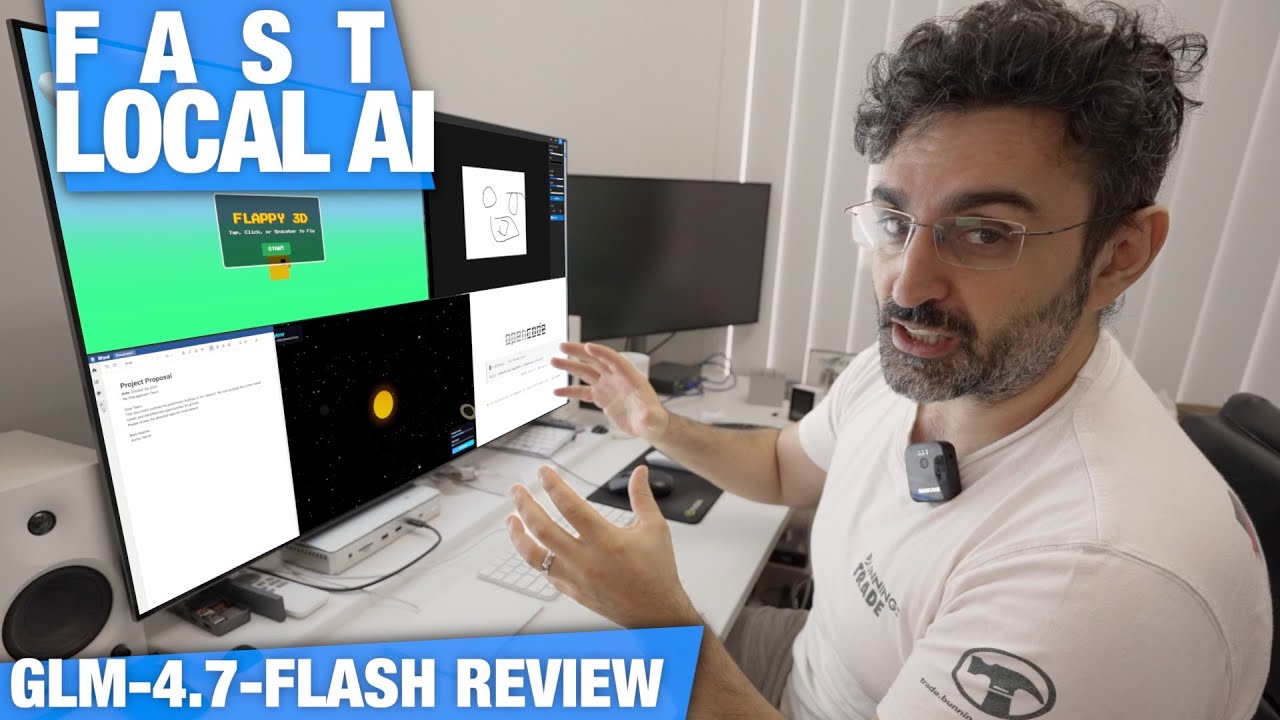
Let's Run GLM-4-7-Flash - Local AI Super-Intelligence for the Rest of Us | REVIEW
Keywords
Summary
142 words
Critical Evaluation
Value of the Information & Strength of the Argument
The video delivers high practical value through systematic benchmarking and real-world application tests. The host measures perplexity, token accuracy, and divergence across quantizations, providing quantitative justification for choosing a specific quant level. Arguments are supported by visible demonstrations of generated apps (Word, Photoshop, Minecraft clones) and by comparing failures between quant levels. The reasoning about temperature effects and quant divergence is logical and supported by data, though the sample size is small and limited to one hardware setup.
Scientific Rigor, Source Quality, Title Accuracy
The content is based on the creator’s own experiments, with no external references beyond product links and companion videos. The host is transparent about test limitations and does not overclaim, but the absence of peer-reviewed sources or cross-validation lowers the reliability. The title includes ‘Super-Intelligence’, which is hyperbolic, yet the video itself is measured. The title matches the content well.
153 words
Title / Content Match
The title accurately reflects the content: a review of running GLM-4.7-Flash locally, including demonstrations and comparisons.
Quality & Reliability
8/10
The video provides detailed hands-on testing with numerical metrics (perplexity, token accuracy, memory usage, tokens/sec) and honest reporting of failures. However, it is a single reviewer with no external validation, and some tests are subjective (e.g., visual quality).
Key Moments
Markers derived by PSI from the transcript: the creator did not define chapters.
- Comparison of unquantized GLM-4.7-Flash, Qwen Coder 30B, and Neotron on a 3D solar system prompt
- Quantization tests (Q4, Q5, Q6, Q8) with token counts, speeds, and memory usage
- Perplexity and token accuracy table; explanation of effective divergence and miss diversion
- Tool call test showing web page content retrieval works on both quantized and unquantized versions
- Coding challenges: Reaxt pattern test and Swift riddle—both fail
- Batching test: running 4 concurrent generations with 120 tokens/sec total throughput and memory up to 160 GB
- MSWord clone demo: features like undo buffer and font changes work well
- Photoshop clone demo: basic drawing and layer adjustments work, but layer system imperfect
- Minecraft and Flappy Birds attempts: Q6 runs Flappy Birds, Q8 gets runtime error
- Coding agent setup with GitHub Copilot and OpenCode, creating a working Tetris game and resolving errors
- Final thoughts: GLM-4.7-Flash is fast and capable for its size, recommended Q6 for most users
Cited Sources
- GLM-4.7-Flash-MLX-5.5bit (Hugging Face) — Model quantization file used for Q5 testing
- GLM-4.7-Flash-MLX-6.5bit (Hugging Face) — Model quantization file used for Q6 testing
- Inferencer App — The application used for running the models and conducting tests
- Companion video: GLM 4.7 — Review of the larger GLM 4.7 model
- Companion video: Kimi K2 Thinking — Review of another model for comparison
- Companion video: Z-Image-Turbo — Review of image generation model
- Companion video: Mac Studio Review — Review of the hardware used in tests
- Thinking version of this video — Alternative version with thinking enabled
External References
Contribution & Novelties
This video provides a practical, hands-on evaluation of the newly released GLM-4.7-Flash model, focusing on local performance across different quantization levels. It offers novel insights into how quant level affects output quality and speed, particularly showing that Q6 can outperform Q8 in some scenarios due to temperature-induced variability. The batching test demonstrates the model’s ability to handle multiple concurrent generations efficiently, which is valuable for local AI workflows.
Pour aller plus loin :
- Quantization (machine learning) — Relevant to the quantization levels tested in the video.
- Mixture of experts — GLM-4.7-Flash uses a MoE architecture, relevant to understanding its parameter efficiency.
- Perplexity — The metric used to evaluate token prediction confidence in the video.
- OpenCode — The coding agent integration shown in the video, though the URL is approximate; may require verification.
- GitHub Copilot — The other coding agent used for local model integration.
144 words
Radar Profile
The radar profile indicates high scores in information quantity, quality, and technical depth, reflecting the video's comprehensive benchmarks and detailed explanations. Reliability is slightly lower due to the absence of external verification and the subjective nature of some visual quality assessments.