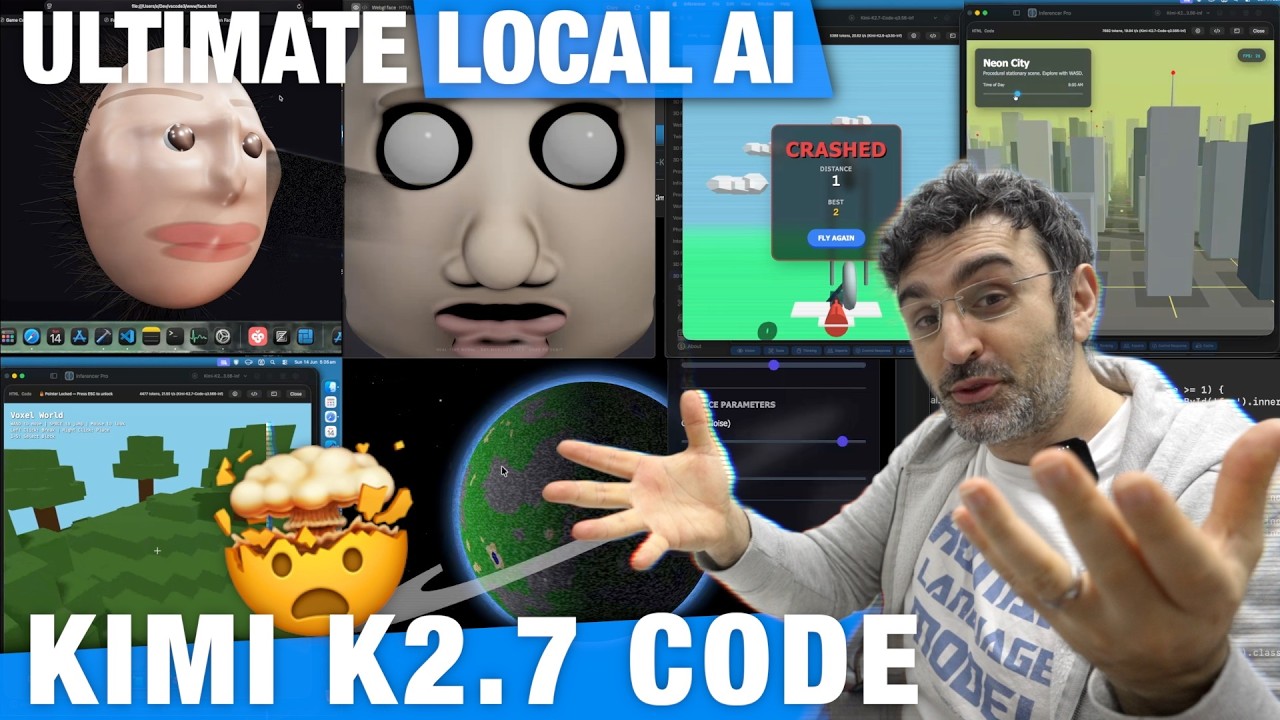
Kimi K2.7 Code Local AI BEATS Claude Max? 🤯 | In-Depth REVIEW
Keywords
Summary
141 words
Critical Evaluation
Value of the Information & Strength of the Argument
The video’s value lies in its hands-on, multi-environment testing of a newly released model, providing practical insights for users interested in running AI locally. The argumentation is supported by concrete examples, side-by-side comparisons with Kimi K2.6 and Claude, and attention to details like token generation speed and output quality. However, the methodology is not rigorous: tests are performed with single seeds, arbitrary quantization levels, and limited repetitions. The reasoning often leans on subjective visual assessment rather than quantitative metrics, and comparisons with Claude are constrained by cloud credit limits. The creator’s enthusiasm and engaging presentation compensate partially, but the overall argumentation could be strengthened by more systematic testing and statistical reliability.
Scientific Rigor, Source Quality, Title Accuracy
The title is attention-grabbing and slightly clickbaity, but the content genuinely delivers an in-depth comparison, including local runs and comparisons with Claude Max. Sources referenced are mostly the model’s own benchmark cards and the developer’s claims, with links to HuggingFace and the Inferencer platform. The creator also mentions companion videos and demonstrates hands-on results, which adds credibility. However, no external peer-reviewed sources or reproducibility details are provided. The review acknowledges potential issues like quantization and seed variability, showing a degree of self-awareness. Overall, the rigor is moderate for a YouTube review, but it clearly communicates the limitations of the tests.
226 words
Title / Content Match
The title accurately reflects the content: an in-depth review comparing Kimi K2.7 Code locally and against Claude Max, covering coding, logic, and math tests.
Quality & Reliability
6/10
The review is hands-on and shows concrete outputs, but relies on single runs, arbitrary quantization choices, and lacks formal methodology. Some claims about improvements are anecdotal, and the comparison with Claude is limited by cloud credit constraints.
Chapters
Cited Sources
- Kimi K2.7 Code on HuggingFace — Model repository for the quantized versions used in the local tests.
- Inferencer App — Platform used for running the model locally and in distributed compute.
- MTP AI Harness — Companion video explaining the AI harness used for testing.
- Kimi K2.6 Review — Previous review of Kimi K2.6 for comparison.
- GLM 5.1 Review — Companion video reviewing another model for context.
External References
Contribution & Novelties
The video provides original, hands-on testing of the newly released Kimi K2.7 Code model in multiple configurations (local, distributed, cloud) and against Claude, offering practical insights for AI enthusiasts. It also demonstrates the effect of quantization and distributed inference on performance. The creator shows that K2.7 produces more detailed outputs than K2.6 in several creative coding tasks, though math reasoning shows potential regressions.
Pour aller plus loin :
- Large language model — Provides background on the architecture and capabilities of models like Kimi K2.7.
- Mixture of experts — Likely the underlying architecture of K2.7, given its size and efficiency.
- Quantization — A key technique enabling local inference on consumer hardware, as demonstrated in the video. No URL provided due to uncertainty.
121 words
Radar Profile
The radar profile shows high quantity of information, moderate quality and technical depth, and moderate reliability. The video is rich in examples and tests, but the methodology is not fully rigorous, reducing confidence in the findings.