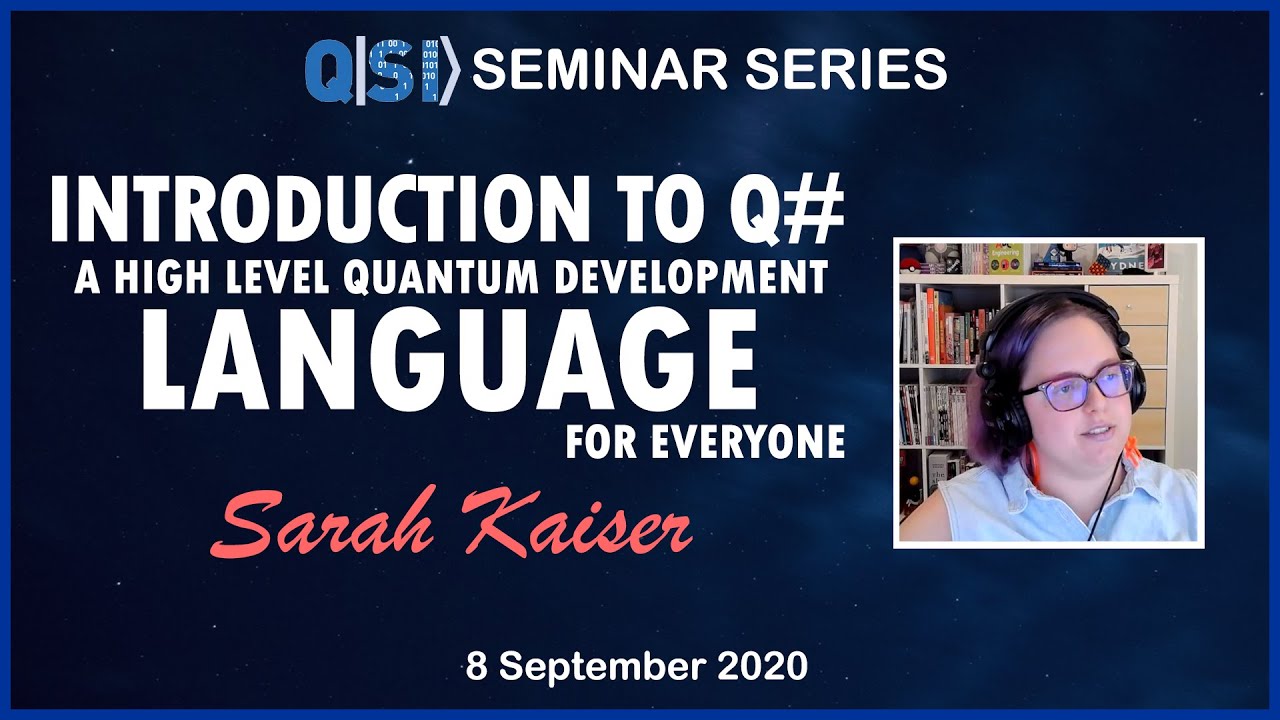
QSI Seminar: Dr Sarah Kaiser, Independent Researcher/Consultant, WA, USA, Introduction to Q#, 08/09
Keywords
Summary
188 words
Critical Evaluation
Value of the Information & Strength of the Argument
The talk provides valuable insights into Q# and quantum programming, with a clear and logical structure. The speaker’s arguments are well-supported by practical examples and her experience in the field. She effectively demonstrates the benefits of Q# for research, such as hardware abstraction and resource estimation, and makes a compelling case for open-source development in quantum computing. The case study on qRAM illustrates the practical application of Q# in a research context, adding credibility to her claims.
Scientific Rigor, Source Quality, Title Accuracy
The scientific rigor is high, as the speaker is an expert in the field and provides accurate information about Q# and quantum computing concepts. She cites relevant open-source projects and resources, including the Q# Community and the qRAM repository. The title accurately reflects the content, and the talk is well-structured. The speaker also acknowledges funding from the Unitary Fund, demonstrating transparency. The content is consistent with current knowledge in quantum computing, and no significant inaccuracies were noted.
169 words
Title / Content Match
The title accurately reflects the content: a comprehensive introduction to Q# for a general audience.
Quality & Reliability
8/10
The talk is given by an experienced researcher and practitioner in quantum computing, with clear explanations and practical demonstrations. The content is consistent with established knowledge about Q# and quantum programming. The speaker provides references to open-source projects and resources, but the talk is primarily a tutorial rather than a rigorous scientific presentation.
Key Moments
Markers derived by PSI from the transcript: the creator did not define chapters.
- Introduction and speaker bio
- Overview of quantum software tools and selection criteria
- Introduction to Q# and the Quantum Development Kit
- Writing functions and operations in Q#
- Example: quantum random number generator
- Functors: adjoint and controlled operations
- Running Q# in Jupyter notebooks and other hosts
- Target machines: simulator, resource estimator, and trace
- Unit testing in Q# for research
- Case study: implementing qRAM in Q#
- Open-source tools and community resources
Cited Sources
- Q# Community — Community for Q# developers and users
- qRAM repository — Open-source implementation of qRAM in Q#
- Women in Quantum Computing & Applications — Organization supporting women in quantum computing
- Learn Quantum Computing with Python and Q# — Book by Sarah Kaiser and Chris Granade
- Sarah Kaiser's webpage — Personal website of the speaker
- UTS Centre for Quantum Software and Information — Hosting institution
- Chris Ferrie's webpage — Host's personal website
- Python Workshop: Quantum Information Science — Workshop materials by QuinnPhys
Concurring Sources
- Q# documentation — Official documentation aligns with the talk's content.
- Quantum Open Source Foundation — Lists many quantum software tools mentioned in the talk.
External References
Contribution & Novelties
The talk provides a practical introduction to Q# and demonstrates its application in quantum research, particularly through the qRAM case study. It highlights the importance of open-source development and reproducibility in quantum computing. The speaker’s perspective as an independent researcher adds value, as she shares real-world experiences and resources.
Pour aller plus loin :
- Q# documentation — Official documentation for Q# and the Quantum Development Kit.
- Quantum Open Source Foundation — Organization promoting open-source quantum software.
- Unitary Fund — Non-profit supporting open-source quantum projects.
- Quantum Computing Report — Overview of quantum computing landscape.
93 words
Radar Profile
The radar profile shows high scores in quantity and quality of information, with a moderate technical level. The talk is well-balanced, providing both theoretical and practical insights. The fiabilite_globale is high, reflecting the speaker's expertise and the consistency of the content.
💬 No comments were provided for analysis.