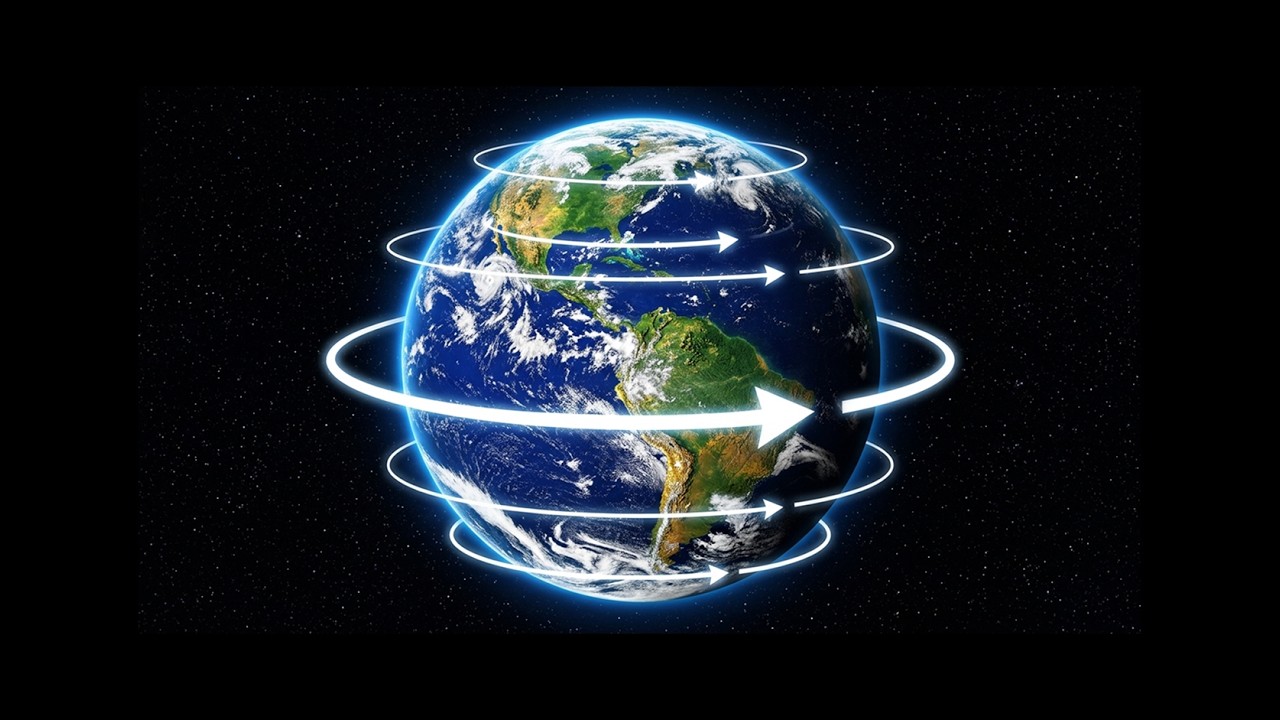
Pourquoi Nous Ne Ressentons Pas La Rotation De La Terre
Why We Don't Feel The Earth's Rotation
Keywords
Summary
145 words
Critical Evaluation
Value of the Information & Strength of the Argument
The video provides valuable educational content, using clear analogies (train, car, merry-go-round) to explain complex physics concepts. The argumentation is solid, building from everyday experiences to more abstract principles. It correctly distinguishes between constant velocity (undetectable) and acceleration (detectable), and explains the role of the vestibular system. The inclusion of the Foucault pendulum as historical proof is well-integrated. The video also demonstrates scientific honesty by acknowledging uncertainties in the extreme scenario calculations, which strengthens its credibility.
Scientific Rigor, Source Quality, Title Accuracy
The scientific rigor is generally good, with accurate explanations of inertia, relativity, and centrifugal force. However, the video does not cite specific scientific sources, relying instead on general knowledge. The title accurately reflects the content. The video mentions the work of Galileo, Newton, and Foucault, but without providing references. The description includes no links to further reading. The discussion of Earth’s shape (oblate spheroid) is historically accurate, referencing the debate between Newton and Cassini. Overall, the content is reliable for a general audience, but lacks the depth of a peer-reviewed source.
182 words
Title / Content Match
The title accurately reflects the content, which thoroughly explains why we don't feel Earth's rotation.
Quality & Reliability
7/10
The video provides a clear and accurate explanation of fundamental physics concepts (inertia, relativity, centrifugal force) and historical experiments (Foucault pendulum). It includes a notable caveat about the accuracy of extreme scenario numbers, showing scientific honesty. However, it lacks direct citations to primary sources and contains minor simplifications.
Key Moments
Markers derived by PSI from the transcript: the creator did not define chapters.
- Introduction: Earth's rotation speed and the paradox of not feeling it.
- Train analogy: constant velocity is undetectable; vestibular system only senses acceleration.
- Car and fly analogy: closed system moves together; atmosphere moves with Earth.
- Merry-go-round and washing machine: centrifugal force; Earth's equatorial bulge.
- Hypothetical: Earth spins faster; oceans migrate to equator, days shorten.
- Hypothetical: Earth stops suddenly; inertia causes 1670 km/h winds and tsunamis.
- Moon's tidal braking: Earth's rotation is slowing; day length increases.
- Principle of relativity: Galileo's ship; uniform motion is undetectable.
- Foucault pendulum: first experimental proof of Earth's rotation; 1851 Paris experiment.
- Earth's shape: oblate spheroid; Newton vs. Cassini debate.
Cited Sources
- Dialogue Concerning the Two Chief World Systems (Galileo, 1632) — Mentioned as the origin of the relativity principle with the ship analogy.
- Philosophiæ Naturalis Principia Mathematica (Newton, 1687) — Cited as a foundation of classical mechanics and the relativity principle.
- Foucault pendulum experiment (1851) — Described as the first experimental demonstration of Earth's rotation.
Concurring Sources
- NASA - Earth's Rotation — Confirms Earth's rotation speed and its effects.
Contribution & Novelties
The video’s original contribution lies in its clear, accessible explanation of why we don’t feel Earth’s rotation, using multiple analogies and thought experiments. It effectively bridges everyday experience with fundamental physics principles. The inclusion of the Foucault pendulum as a historical proof adds depth.
Pour aller plus loin :
- Foucault pendulum — Detailed explanation of the experiment and its significance.
- Equatorial bulge — Explains the oblate shape of Earth due to rotation.
- Tidal acceleration — Discusses the Moon’s effect on Earth’s rotation.
- Principle of relativity — Foundational concept in physics.
90 words
Radar Profile
The radar profile shows high scores in information quantity and quality, with a moderate technical level. This indicates a well-balanced educational video that is informative and reliable, but not overly technical.