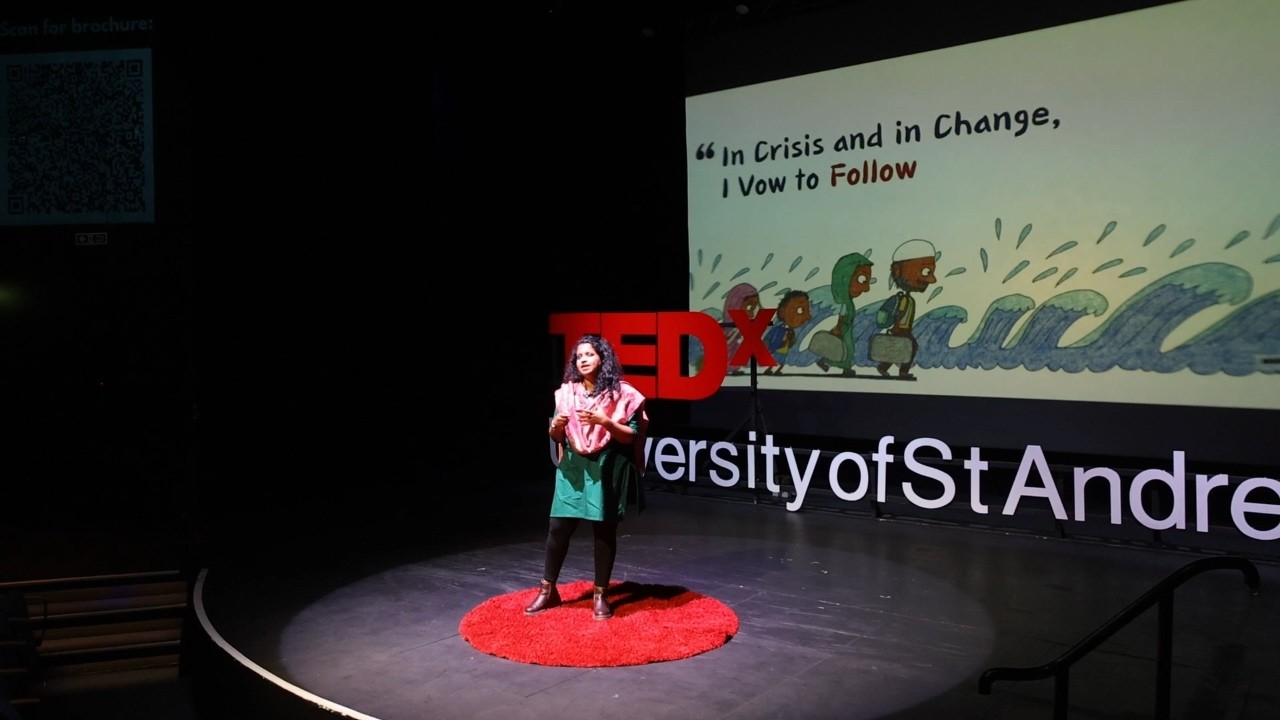
Climate Brides | Dr Reetika Revathy Subramanian | TEDxUniversityofStAndrews
Keywords
Summary
153 words
Critical Evaluation
Value of the Information & Strength of the Argument
The talk provides valuable insights into the under-discussed nexus of climate change and child marriage, offering a nuanced perspective that moves beyond simplistic cultural explanations. The speaker’s argument is well-structured, using personal narratives and regional examples to illustrate complex socio-environmental dynamics. She effectively challenges the separation of climate and cultural issues, showing how they intersect in the lived experiences of vulnerable communities. The argumentation is compelling, though it relies more on qualitative evidence and personal observation than on quantitative data or systematic analysis.
Scientific Rigor, Source Quality, Title Accuracy
The talk demonstrates scientific rigor through the speaker’s evident expertise and field research, but it lacks explicit citations of specific studies or reports. The description mentions the ‘Climate Brides project’ and the speaker’s affiliation with the University of East Anglia, lending credibility. The title accurately reflects the content, which focuses on the concept of ‘climate brides’ and the intersection of climate change and child marriage. The talk is well-aligned with its title, though it could benefit from more concrete data and references to strengthen its scientific foundation.
185 words
Title / Content Match
The title accurately reflects the core theme of the talk, which focuses on the intersection of climate change and child marriage.
Quality & Reliability
8/10
The talk is grounded in the speaker's research and field observations, referencing specific cases (e.g., Marathwada, Bangladesh, Afghanistan) and data from international organizations. However, specific sources are not cited in the talk, and the evidence is largely anecdotal and qualitative.
Key Moments
Markers derived by PSI from the transcript: the creator did not define chapters.
- Introduction of the 'climate brides' concept through the story of Sonel and Kajal in Marathwada.
- Discussion of the global scale of climate-related child marriage in South Asia.
- Explanation of the 'promise' of marriage as a survival strategy in times of crisis.
- Analysis of the first vow: 'to follow' and how climate migration intertwines with marriage.
- Second vow: 'to provide' and the economic exchanges (dowry, bride price) in climate-stressed regions.
- Third vow: 'to bear the burden' and the invisible labor of women and girls in climate adaptation.
- Call to action: widening choices and ensuring climate justice for future generations.
Cited Sources
- TEDx Talks — Mentioned in the video description as the platform for the talk.
Concurring Sources
- UNICEF: Child marriage and climate change — Supports the claim that climate change exacerbates child marriage.
- UN Women: Gender and climate change — Reinforces the link between gender inequality and climate impacts.
Dissenting Sources
- No direct discordant sources found — The talk does not present conflicting evidence, but some might argue that the causal link between climate change and child marriage is not fully established in the talk.
Contribution & Novelties
The talk introduces the term ‘climate brides’ to describe child marriages precipitated by climate change, offering a new lens on the intersection of environmental and social issues. It provides a qualitative framework for understanding how climate shocks and long-term stressors influence family decisions, particularly around marriage. The speaker’s field observations and narratives add a human dimension to the discussion, highlighting the lived experiences of affected communities.
Pour aller plus loin :
- Child marriage and climate change — UNICEF’s overview of the link between climate change and child marriage.
- Climate change and gender — UN Women’s explainer on gender and climate change.
- Marriage and migration in South Asia — ILO report on labour migration in South Asia, relevant to the migration aspect.
121 words
Radar Profile
The radar profile shows high scores in qualitative information and fiabilité, reflecting the speaker's expertise and the richness of narratives. However, the lower score in niveau technique indicates that the talk is accessible to a general audience, with limited technical depth. The overall profile suggests a well-balanced, credible presentation that prioritizes human stories over quantitative analysis.