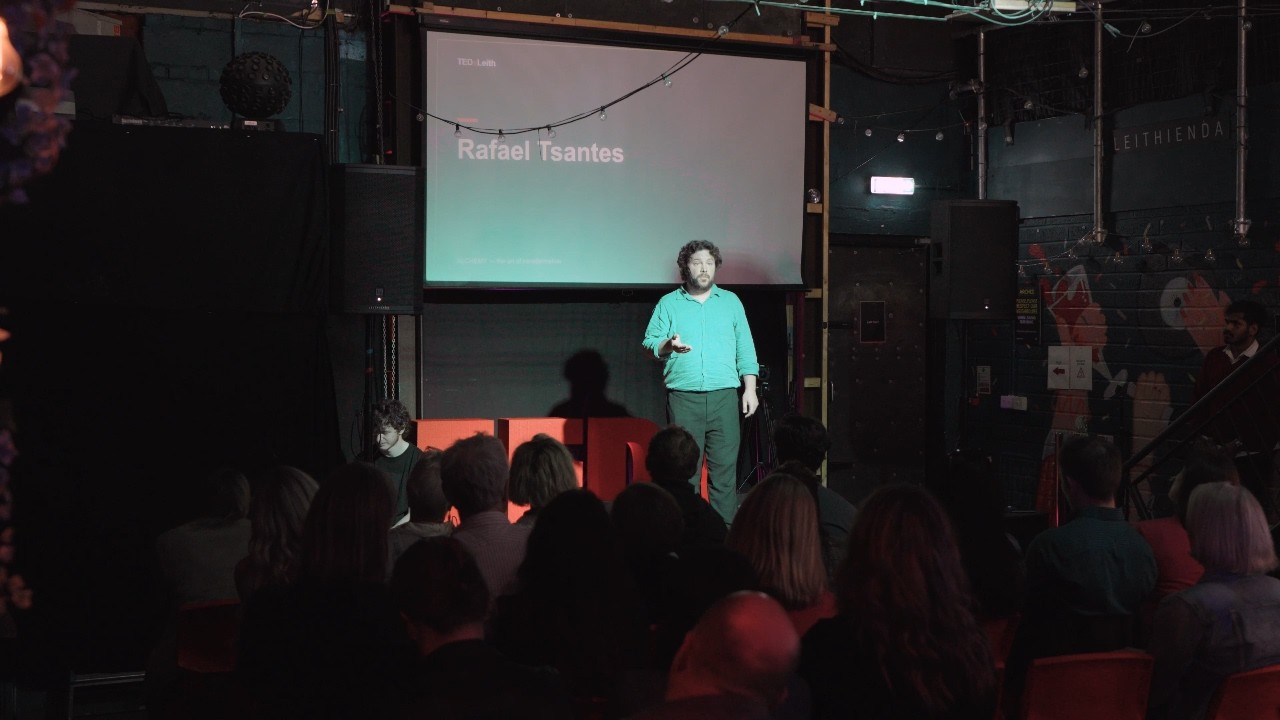
Survival Design | Rafael Tsantes | TEDxLeith
Keywords
Summary
143 words
Critical Evaluation
Value of the Information & Strength of the Argument
The talk’s value lies in its reframing of career failure as a systemic issue rather than an individual one, offering a perspective that resonates with many facing similar struggles. The argument is built on a personal narrative that is compelling and relatable, supported by references to established sociological and psychological concepts (fundamental attribution error, social capital). However, the argumentation relies heavily on anecdotal evidence and lacks empirical data or specific studies to substantiate the claims. The speaker’s use of design thinking as a framework is insightful, but the connection between the concept and its application to career navigation could be more deeply explored. Overall, the argument is persuasive on an emotional level but lacks the rigor of a fully evidence-based analysis.
Scientific Rigor, Source Quality, Title Accuracy
The talk demonstrates moderate scientific rigor. It references well-known concepts (fundamental attribution error, social capital, design thinking) but does not provide specific citations or data to support the claims. The speaker mentions organizations like the Sutton Trust but does not give specific studies or findings. The title ‘Survival Design’ is apt and accurately reflects the content. The talk is a personal narrative and expert opinion rather than a research-based presentation. The lack of verifiable sources limits its scientific credibility, but the concepts discussed are legitimate and well-established in their respective fields.
227 words
Title / Content Match
The title 'Survival Design' accurately reflects the core theme of the talk, which frames career navigation under systemic constraints as a design problem.
Quality & Reliability
6/10
The talk is a personal narrative combined with references to established concepts (fundamental attribution error, social capital, design thinking) but lacks direct citations to specific studies or data. The argument is coherent and grounded in personal experience, but the scientific rigor is limited by the absence of verifiable sources.
Key Moments
Markers derived by PSI from the transcript: the creator did not define chapters.
- Introduction: The theme of alchemy and turning instability into strategy.
- Personal story: 18 months of job applications and the realization that the system may be designed as is.
- Career history: biology, theater, and the concept of 'failure' as a label.
- Introduction of the fundamental attribution error and social capital.
- The paradox of entry-level jobs and the role of unpaid internships.
- Design thinking as a survival tool and its origins.
- Conclusion: Nonlinearity as adaptation and the call to redesign systems.
Cited Sources
- TEDx Program — Mentioned as the organizing body for the talk.
Concurring Sources
- Sutton Trust — Mentioned as a research organization on social mobility and access.
Contribution & Novelties
The talk offers a fresh perspective on career failure by framing it as a ‘survival design’ problem, integrating design thinking principles with sociological concepts. It challenges the individualistic narrative of success and provides a framework for understanding systemic barriers. The personal narrative adds authenticity, but the novelty is more in the synthesis of existing ideas than in new research.
Pour aller plus loin :
- Fundamental attribution error — Core concept referenced in the talk.
- Social capital — Key concept for understanding access and networks.
- Design thinking — The problem-solving framework advocated by the speaker.
94 words
Radar Profile
The radar profile shows moderate scores across information quantity, quality, and reliability, with a lower technical level. This reflects a talk that is conceptually rich but lacks empirical depth, making it more of an inspirational and opinion-based piece than a rigorous scientific analysis.
💬 No comments were provided for analysis.