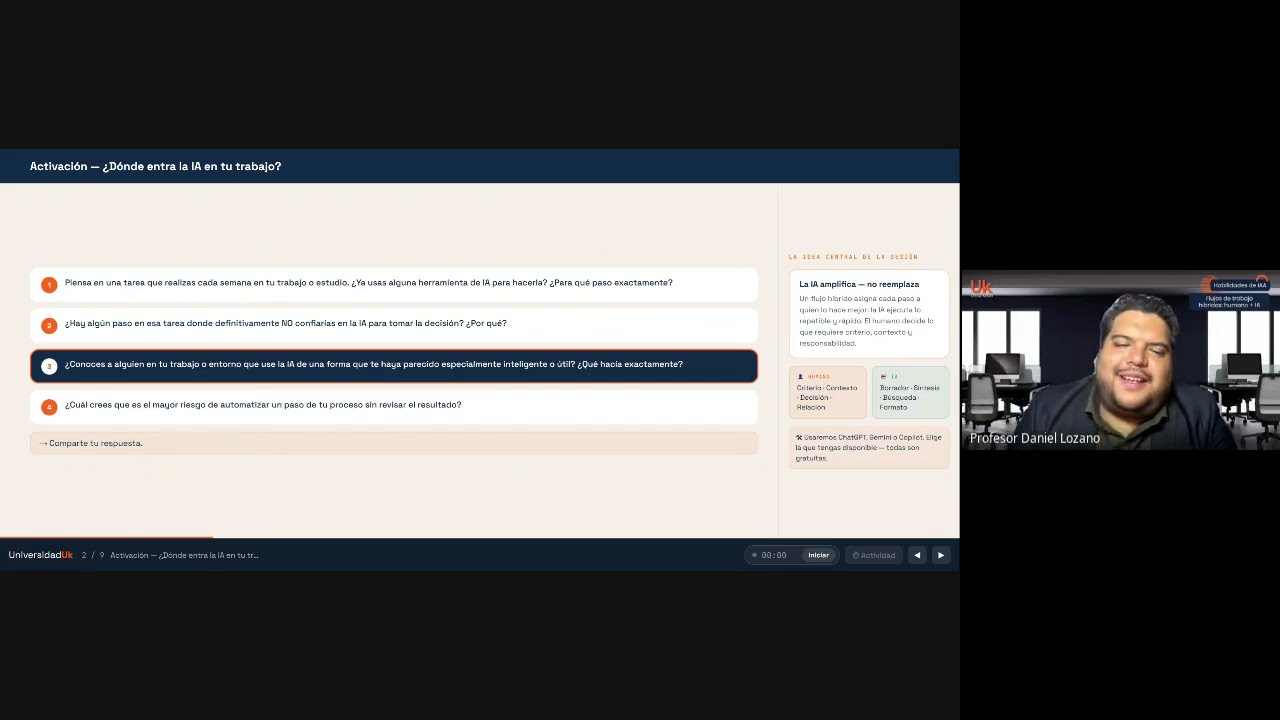
Flujos de trabajo híbridos: humano + IA
Hybrid workflows: human + AI
Keywords
Summary
185 words
Critical Evaluation
Value of the Information & Strength of the Argument
The video provides valuable insights into the practical integration of AI in professional workflows, emphasizing the importance of human oversight. The argumentation is solid, built on the expert testimony of Sylvain Duranton, who presents compelling case studies from his experience at Boston Consulting Group. The examples, such as the fashion retailer forecasting model and the healthcare monitoring protocol, effectively illustrate the benefits of a human-plus-AI approach. The lecture also addresses potential risks, such as algorithmic bias and the dangers of over-reliance on AI, which strengthens the overall argument. However, the content is more opinion-based than evidence-based, relying heavily on anecdotal evidence and expert authority rather than systematic research.
Scientific Rigor, Source Quality, Title Accuracy
The scientific rigor is moderate. The video does not cite specific academic sources, but it references a TED talk by Sylvain Duranton, which is a credible source. The quality of sources is acceptable for an educational lecture, though it lacks formal citations. The title accurately reflects the content, which is focused on hybrid workflows. The lecture is well-structured and the information is presented clearly, but the lack of verifiable references reduces its scientific rigor. The discussion is interactive, with students sharing personal experiences, which adds practical relevance but not academic depth.
214 words
Title / Content Match
The title accurately reflects the content, which focuses on designing hybrid workflows that integrate human judgment with AI capabilities.
Quality & Reliability
7/10
The video is a university lecture that combines expert opinion (Sylvain Duranton's TED talk) with interactive discussion. The content is well-structured and grounded in real-world examples, but it lacks formal citations or references to peer-reviewed studies. The information is reliable for educational purposes, though it is not a rigorous scientific source.
Key Moments
Markers derived by PSI from the transcript: the creator did not define chapters.
- Introduction and class rules
- Activation: discussion on current AI use
- Introduction to hybrid workflows and the concept of algocracy
- TED talk by Sylvain Duranton on human-plus-AI
- Discussion on risks of AI automation
- Mapping workflows: identifying AI vs human steps
- Practical exercise: creating a hybrid workflow map
- Wrap-up and conclusions
Cited Sources
- TED talk by Sylvain Duranton — The lecture features a TED talk by Sylvain Duranton on the dangers of algocracy and the importance of human-in-the-loop AI.
Concurring Sources
- Human-in-the-loop — The concept of keeping humans in the loop is central to the video's message.
- Algorithmic bias — The video discusses risks of AI errors and bias, aligning with this concept.
Dissenting Sources
- AI replacing humans — Some perspectives argue that AI can fully automate certain tasks without human oversight, which contrasts with the video's emphasis on human-in-the-loop.
Contribution & Novelties
The video offers a practical framework for designing hybrid workflows, emphasizing the importance of human oversight. It introduces the concept of ‘algocracy’ and the ‘human-plus-AI’ approach, which is a valuable perspective for professionals integrating AI into their work.
Pour aller plus loin :
- Human-in-the-loop — Relevant concept for understanding the balance between human and AI decision-making.
- Algorithmic bias — Key risk discussed in the video, relevant to AI ethics.
- Boston Consulting Group — The organization where Sylvain Duranton is a leader, providing context for his expertise.
86 words
Radar Profile
The radar profile shows a balanced distribution across all dimensions, with slightly higher scores in information quantity and reliability. This indicates that the video provides a substantial amount of information with a moderate level of technical depth and reliability, making it suitable for educational purposes.