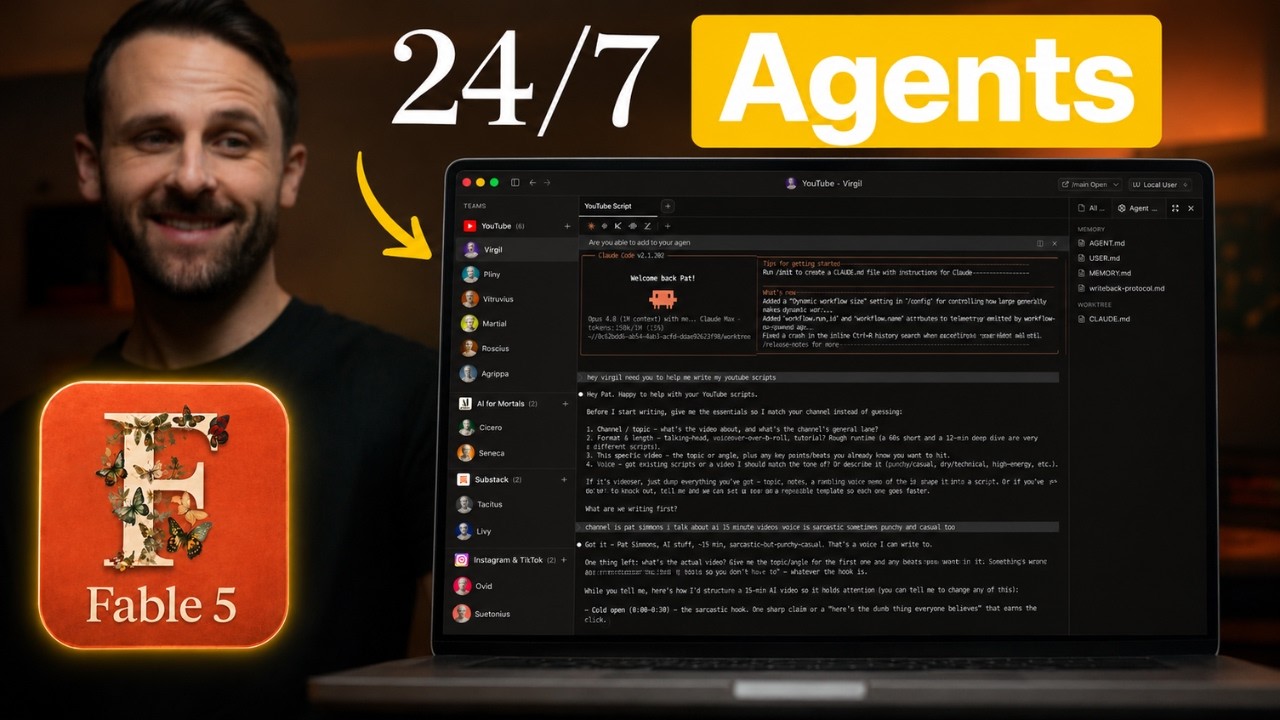
Claude Fable 5 Just Built the Ultimate Agent Harness
Keywords
Summary
148 words
Critical Evaluation
Value of the Information & Strength of the Argument
The video provides a practical, hands-on demonstration of building an ADE, which is valuable for developers interested in agent orchestration. The argumentation is based on the creator’s direct experience, showing the iterative process of using Fable 5 to generate and refine the application. The creator clearly explains the design decisions, such as using OpenRouter for model flexibility and Hermes for memory. However, the video lacks a critical evaluation of the tools used; it presents the process as straightforward without discussing potential limitations or alternatives in depth. The value lies in the concrete example and the resources provided, but the argumentation is more anecdotal than rigorous.
Scientific Rigor, Source Quality, Title Accuracy
The video references several open-source projects (Hermes, Superset) and Anthropic documentation, which are credible sources. The creator provides links to the GitHub repository for the ADE and the orchestration skill. However, the video does not cite any peer-reviewed research or independent evaluations. The title accurately reflects the content, as the video indeed shows the construction of an agent harness using Claude Fable 5. The creator’s claims about the capabilities of Fable 5 are based on his own experience and are not independently verified. Overall, the sources are relevant but not exhaustive, and the title is appropriate.
216 words
Title / Content Match
The title accurately reflects the content: the video shows the construction of an agent harness using Claude Fable 5.
Quality & Reliability
7/10
The video is a practical tutorial demonstrating the construction of an agentic development environment (ADE) using Claude Fable 5. It is based on the creator's direct experience and includes references to open-source projects (e.g., Hermes, Superset) and Anthropic documentation. The approach is transparent, with step-by-step explanations and links to resources. However, the content is largely anecdotal and lacks independent verification or comparative analysis.
Chapters
- The Two Problems With AI Agents
- The Idea (My Mockup)
- Tools That Already Exist (ADEs)
- Building It With Fable 5
- The First Mockup
- Why It's Called "Damon"
- Building the Mac App
- Setting Up My First Agent
- Adding Any Model (OpenRouter)
- Giving Agents Memory (Hermes)
- How to Install It Yourself
- The Onboarding Walkthrough
- What's Next (Agent OS)
Cited Sources
- Damon ADE releases — GitHub repository for the ADE application built in the video.
- Fable orchestration skill — Skill for orchestrating Fable 5, based on Anthropic documentation.
- AI bootcamp — Creator's bootcamp for AI, mentioned in the description.
- AI for mortals newsletter — Newsletter subscription link.
Concurring Sources
- Anthropic documentation on prompting Fable 5 — Referenced in the video as the basis for the orchestration skill.
Contribution & Novelties
The video contributes a practical, step-by-step guide to building a custom ADE using Claude Fable 5, demonstrating how to integrate multiple models and memory systems. It highlights the potential of using existing subscriptions and open-source tools to create a personalized agent orchestration platform.
Pour aller plus loin :
- Agentic Development Environments (ADEs) — Overview of ADEs and their role in AI development.
- OpenRouter — Platform for accessing multiple AI models via a single API, used in the video.
- Hermes (Nous Research) — Open-source project for agent memory and self-improvement, referenced in the video.
93 words
Radar Profile
The radar profile shows high scores in quantity of information and technical level, reflecting the detailed tutorial nature. Quality of information and global reliability are moderate, indicating the content is practical but lacks independent verification.