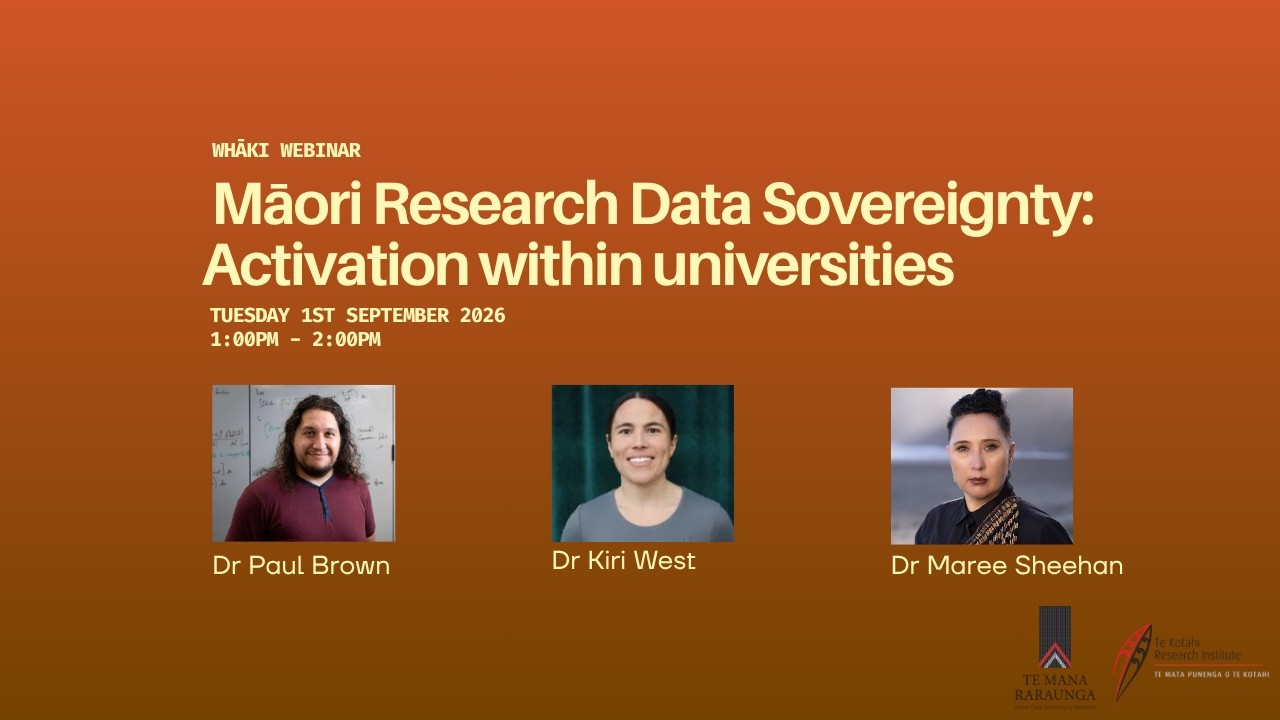
Whāki Webinar Hepetema - Māori Research Data Sovereignty Activation within universities
Keywords
Summary
190 words
Critical Evaluation
Value of the Information & Strength of the Argument
The webinar provides valuable insights into the practical challenges and strategies for implementing Māori data sovereignty in university settings. The argumentation is solid, grounded in the speakers’ research and experience. Dr. Brown’s presentation on findability is particularly strong, offering a novel computational approach that addresses a real gap in data management. The distinction between data sovereignty and governance is clearly articulated, and the emphasis on community authority is well-founded. The speakers acknowledge limitations, such as the need for human verification and the evolving nature of definitions, which adds credibility. However, the argumentation could be strengthened by more concrete examples of governance mechanisms and community engagement outcomes.
Scientific Rigor, Source Quality, Title Accuracy
The webinar demonstrates scientific rigor through its structured research approach and reference to a published research paper (led by Dr. Brown) on defining Māori research data. The speakers cite relevant frameworks, such as Te Mana Raraunga’s principles, and mention institutional documents like the University of Auckland’s strategic plan. The title accurately reflects the content, focusing on activation within universities. The presentation is well-organized, with clear objectives and preliminary data. However, the reliance on ongoing research and the lack of detailed citations for some claims slightly reduce the overall rigor. The webinar does not include a formal Q&A session, but the chat is mentioned for questions.
226 words
Title / Content Match
The title accurately reflects the webinar's focus on activating Māori research data sovereignty within universities, covering findability, governance, and community engagement.
Quality & Reliability
7/10
The webinar features three researchers with relevant expertise in Māori data sovereignty, statistics, and indigenous research. They present a funded research project with clear objectives and preliminary findings, including quantitative results from a computational classification model. However, the content is largely based on ongoing work and personal perspectives, with limited peer-reviewed evidence presented in the talk itself.
Key Moments
Markers derived by PSI from the transcript: the creator did not define chapters.
- Introduction and housekeeping by host Lee Timutimu.
- Dr. Kiri West introduces the research project on activating Māori data sovereignty in universities.
- Definition of Māori research data and distinction between data sovereignty and governance.
- Dr. Paul Brown presents the findability objective and challenges in locating historic Māori research data.
- Description of the computational methodology using LLMs to classify research records.
- Preliminary results: 1,836 records flagged, 88.3% recall rate, and 66% verification rate.
- Dr. Kiri West discusses governance, using the University of Auckland as a case study.
- Presentation of the data capability maturity model and its alignment with Māori data sovereignty principles.
- Discussion on the need for community engagement and connection to data.
- Wrap-up and future directions for the project.
Cited Sources
- Research paper on defining Māori research data (led by Dr. Paul Brown) — Mentioned by Dr. Kiri West as available online, providing a working definition of Māori research data.
- University of Auckland Strategic Plan 2020-2030 — Referenced as containing the aspiration to be a Māori data sovereignty organization.
- Te Mana Raraunga principles — Mentioned as the basis for the data capability maturity model.
Concurring Sources
- Te Mana Raraunga – Māori Data Sovereignty Network — The network's principles align with the webinar's emphasis on Māori data sovereignty and governance.
- CARE Principles for Indigenous Data Governance — These principles support the webinar's call for community control and engagement in data governance.
Dissenting Sources
- FAIR Principles — While FAIR principles are widely adopted, they do not inherently address Indigenous data sovereignty, and the webinar implicitly critiques their limitations for Māori data.
Contribution & Novelties
The webinar contributes original insights into the practical activation of Māori data sovereignty within universities, particularly through the development of a computational method for identifying historic Māori research data. This approach addresses a significant gap in data findability and offers a scalable methodology. The distinction between data sovereignty and governance is clearly articulated, and the emphasis on community authority is a valuable contribution to the discourse.
Pour aller plus loin :
- Māori Data Sovereignty Network — Official site of Te Mana Raraunga, providing resources and principles on Māori data sovereignty.
- FAIR Principles — Foundational principles for data management, relevant to the findability discussion.
- CARE Principles for Indigenous Data Governance — Complementary principles emphasizing collective benefit and control, directly relevant to the governance and community engagement aspects.
126 words
Radar Profile
The radar profile shows a balanced performance across all dimensions, with slightly higher scores in information quality and reliability, reflecting the expert-driven content. The technical level is moderate, indicating accessibility to a general audience while still providing depth.
💬 Sur les 0 commentaires analysés, aucune tendance n'a pu être dégagée.